DENSITY
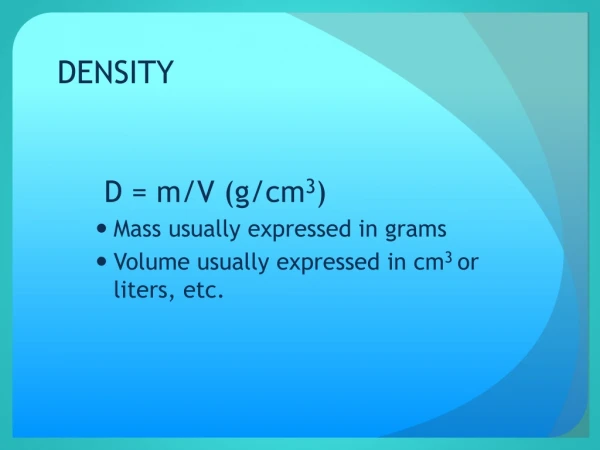
Density is a fundamental physical property defined as mass per unit volume. This concept explains why different substances with the same volume have different weights. For example, liquids like water have a density of 1000 kg/m³, while ice is less dense at 920 kg/m³. Density can be calculated using the formula ( text{Density} = frac{text{Mass}}{text{Volume}} ). This guide covers various methods to determine the density of solids, liquids, and gases through displacement and measurement techniques, ensuring a comprehensive understanding of density in practical scenarios.

DENSITY
E N D
Presentation Transcript
What is Density? If you take the same volume of different substances, then they will weigh different amounts. Density is the Mass per unit Volume Wood Water Iron 1 cm3 1 cm3 1 cm3 IRON 0.50 g 1.00 g 8.00 g Q) Which has the greatest mass and therefore the most dense?
m V Density Equation: g or kg Mass Density = Volume gcm-3 or kgm-3 cm3 or kg3 • = m V Example: Q) Liquid water has a density of 1000kgm-3, while ice has density of 920kgm-3. Calculate the volume occupied by 0.25kg of each. V= m = 0.25 = 0.000250m3 1000 V = m = 0.25 = 0.000272m3 920
DENSITY OF A REGULAR SOLID • Find the Mass of the solid on a balance. • Measure the three lengths and calculate the Volume. (ie V = l x w x h ) • Calculate the Density. m = 240 g 2.0 cm = m = 240 =10.0 g/cm3 V 24 3.0 cm 4.0 cm
DENSITY OF AN IRREGULAR SOLID m = 360 g = m = 360 =12.0 g/cm3 V 30 • Find the Mass of the solid on a balance. • Fill the Measuring Cylinder with Water to a known Volume. • Add the Object. • Work out the Volume of Water that is displaced. • Calculate the Density. 80 cm3 50 cm3
DENSITY OF AN IRREGULAR SOLID • OR use a Eureka Can to find the Volume. • Find the mass of the solid on a balance. • Add water until just overflowing. • Place a Measuring Cylinder under the spout. • Add the Object. • Collect the Water and read off the Volume. • Calculate Density m = 440 g 40.0 cm3 = m = 440 =11.0 g/cm3 V 40
Mass of Liquid = Mass of Measuring Cylinder and Liquid – Mass of empty Measuring Cylinder DENSITY OF A LIQUID • Find the Mass of an empty Measuring Cylinder. • Add a certain Volume of Liquid. • Find the Mass of the Measuring Cylinder and Liquid • Calculate the Mass of Liquid. • How? • Calculate Density of Liquid. 25.0 g 45.0 g 20.0 cm3 45 – 25 = 20 g = m = 20 =1.00 g/cm3 V 20
DENSITY OF A GAS • Remove the air from a flask of a known Volume, using a vacuum pump. • Find its Mass. • Add the gas to be tested. • Reweigh. • The difference is the Mass of gas. • Calculate Density. To vacuum flask 150.0 g 170.0 g 1000 cm3 170 -150 = 20.0g = m = 20 =0.0200 g/cm3 V 1000