Understanding Memory: Types, Processes, and Storage Mechanisms
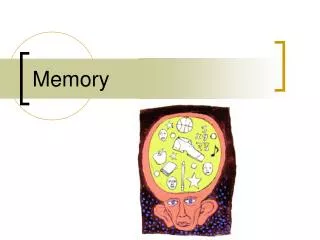
This overview explores different types of memory: declarative (factual and episodic) and non-declarative (procedural). Declarative memory, managed by the hippocampus and cortex, includes personal experiences and general knowledge. Non-declarative memory relates to skills and actions, often beyond conscious awareness. Key memory processes—encoding, storage, and retrieval—are examined, including techniques like elaboration and visual imagery. The information processing theory outlines how sensory and short-term memories lead to long-term storage, emphasizing the roles of rehearsal, interference, and chunking in memory retention.

Understanding Memory: Types, Processes, and Storage Mechanisms
E N D
Presentation Transcript
Declarative- factual information handled by hippocampus & areas of the cortex Episodic- personal facts and experiences Like an autobiography Maybe unique to humans Ex: first day of school Semantic- general, factual knowledge Ex: knowing the state capitals Like an encyclopedia NonDeclarative/Pro-cedural- actions and skills (muscle memory) Little conscious awareness Ex: riding a bike Performance decreases if you think too much Doesn’t decline much Cerebellum and amygdala Memory Systems
3 Key Processes of Memory Encoding Storage Retrieval Encoding- forming a memory code Storage- maintaining encoded information over time Retrieval- recovering information from memory stores
Encoding • Encoding Techniques • Elaboration • Visual Imagery
Storage Information Processing Theory- incoming information passes through 2 temporary areas of storage (sensory & short-term) and then is transferred to long-term storage Sensory Short Term Long Term (working)
Sensory Memory • Allows sensation to linger for a brief moment after stimulus is presented • Less than a second • Ex: afterimage • Experiment with Trigrams!
Practice Round AGB TJK WLP
MIDDLE TJK
Round 1 MKL WDC BGT
BOTTOM BGT
Round 2 ZXA QKI NHY
TOP ZXA
Round 3 XCV BHY OTR
TOP XCV
Round 4 DWS VFT GXC
BOTTOM GXC
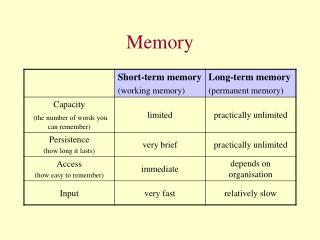
Short-term memory (STM) • Limited capacity (7-9 items) • Limited duration (up to 20 sec.) • Rehearsal- Repeating information • causes STM to last longer • Interference- new info pushes out old • EXPERIMENT! • Chunking- combining separate items • EXPERIMENT! • Serial-Position Effect (primacy/recency)- better recall of info from beginning and end of list
Long-Term Memory (LTM) • Unlimited capacity over long periods of time • Flashbulb Memories- vivid & detailed recollections of momentous events in our life