Understanding Voter Participation: Influences, Qualifications, and Political Socialization
This chapter explores the multifaceted influences on the election process, particularly focusing on voter participation. It examines essential concepts such as suffrage, the electorate, and voter qualifications, including the historical context of voter rights through amendments and civil rights legislation. The chapter also discusses political socialization and various factors that affect voter behavior, including demographics and personal characteristics. Additionally, it highlights the effects of redistricting and gerrymandering on electoral politics.

Understanding Voter Participation: Influences, Qualifications, and Political Socialization
E N D
Presentation Transcript
Chapter 6 Influences on the election process
Voter Participation • Franchise/Suffrage – right to vote • Electorate – potential voting population
Voter Qualifications Must live in the state in which you registered (time varies by state) Registered (all but ND) No constitutional declaration that aliens cannot vote (states) No more religious qualifications, property ownership, literacy tests, poll taxes, or discrimination (except 18)
15th Amendment • 1870-the right to vote cannot be denied to any citizen of the US because of race, color, or previous condition of servitude • Passed but the gov’t paid little attention to the AA right to vote. • Used violence, loss of job, credit, or literacy test
Civil Rights Act of 1957 • Civil Rights Commission-to look into claims of voter discrimination • 1960-federal voting referees to help people to vote in federal elections
Civil Rights Act of 1964 • Cannot use any registration requirement to be unfair or discriminatory
Ineligible to vote • Mentally incompetent • Serious felons • Dishonorable discharge (some), • Homeless (some), • Polygamists (some)
Political Socialization • Process by which people gain their political attitudes and opinions
Political Socialization • Family/Friends • Schools/Church • Media • Interest Groups
Redistricting -Census every 10 years -Population shifts -State legislatures draw lines…who is in power?
Gerrymandering • Drawing the lines of electoral districts in order to limit the voting strength of a particular group or party (census)
“Idiot” • From the Greek “idiotes” – citizens who did not vote or take part in public life (ignorant of public affairs) • Choose not to vote, “ballot fatigue”, off-year elections
Why are voters apathetic? • Whoever wins, nothing will change • No sense of Political Efficacy(special interests, media, etc. have the power) • Inconvenient • Weather • Time-zone fallout
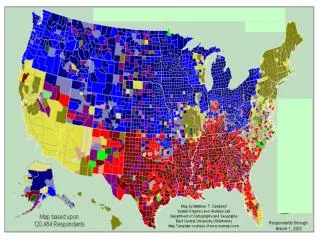
Who votes? • Higher incomes • Higher education • Higher occupational status • Strong sense of party identification • Over 35, married, non south, urban
Factors that influence voters • Voter’s personal characteristics – age, race, income, occupation, education, religion, … • Voter’s group affiliations – family, co-workers, friends, …
Identify trends in each category on p. 167 • A 35 year old African American Catholic male with a college degree who is employed as a bank manager living in the south.
Identify trends in each category on p. 167 • A 25 year old Hispanic Catholic female with a high school degree who works as a department store clerk in the west.
Identify trends in each category on p. 167 • A 55 year old white protestant female with a college degree who is a retired accountant living in the east.
Identify trends in each category on p. 167 Pick either the Democratic party or Republican party: Identify all areas where they have gained ground, lost ground, and maintained ground.