Enhancing Entrepreneurship in SME Development and Export Consortia | Khon Kaen, Thailand
Join us from August 9 to September 3, 2010, for a transformative training program focused on enhancing entrepreneurship in small and medium enterprises (SMEs) and export consortia. Sponsored by TICA and organized by Mekong Institute, this course aims to develop participants' understanding of sustainable enterprise development and effective private sector strategies. Through interactive modules, study visits, and expert-led sessions, participants will gain insights into business management, growth strategies, and B2B networks, enriching their capacity to foster local and regional SME advancements.

Enhancing Entrepreneurship in SME Development and Export Consortia | Khon Kaen, Thailand
E N D
Presentation Transcript
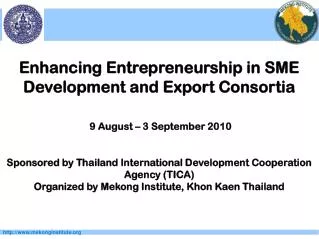
Enhancing Entrepreneurship in SME Development and Export Consortia9 August – 3 September 2010Sponsored by Thailand International Development Cooperation Agency (TICA)Organized by Mekong Institute, Khon Kaen Thailand
Objectives To develop participants’ appreciation of the importance and significance - and complexity - of sustainable enterprise development in a national and regional context; To develop the capacity of participants to assess and consider more effective enterprise and private sector development strategies and activities in their own countries.
Course Modules Module 1: Unleashing Entrepreneurship: Setting the Context Module 2: The Essentials of Enterprise Development: Why and How? Module 3: Ensuring Business Survival and Sustainable Growth Module 4: Managing Enterprise (through study visits) Module 5: Developing Clusters and Business-to-Business Networks (B2BN)
Course Modules Module 1: Unleashing Entrepreneurship: Setting the Context Scope: • Getting to know each other; • Setting the context (training contents and • methodology); • Exploring expectations; • Developing norms and codes of conduct • during the training; • Orientation to the SME Development and • Export Consortia in the GMS.
Course Modules Module 2: The Essentials of Enterprise Development: Why and How? Scope : • Enterprises and their contexts; • Why and how to promote enterprises?
Course Modules Module 3: Ensuring Business Survival and Sustainable Growth Scope : • Main area of enterprise development; • Enabling environment; • Business development and financial services; • Productivity and competitiveness in enterprises; • Improving value and supply chains.
Course Modules Module 4: Managing Enterprise (through study visits) Scope : • structured learning visits to various • business enterprises and business • development service organizations • in Thailand
Course Modules Module 5: Developing Clusters and Business-to-Business Networks (B2BN) Scope : • Developing clusters; • Business-to-Business Networks (B2BN); • Lessons learned and best practices of B2B in the GMS and from OTOP to international market; • Export consortia • Structured Learning Visit to different SME clusters and export consortia.
Learning Activities and Methodologies • Interact Presentations • Case studies / Media • Class discussion / brainstorming • Questions and answers • Group assignments • Role play / games / exercise • Structural learning visits • Group presentation • Individual Action Plan • Internet searching
Resource Persons • Dr. Suchat Katima, MI Director • Dr. John Walsh, Shinawatra University, Bangkok • Dr. Masato Abe, UNESCAP, Bangkok • Dr. Nittana Southiseng, Shinawatra University, Bangkok • Mr. Kanit, Small and Medium Enterprise Bank of Thailand, Bangkok • Mr. Stephen Salmon, Thai Craft Fair Trade Co., Ltd. Bangkok • Mr. Oudet Suvannavong, Greater Mekong Sub-region Business Forum, Vientiane, Lao PDR
Structural Learning Visits • Khon Kaen Ceramic Co., Ltd. Khon Kaen • Sriviroj Farm Co., Ltd., Khon Kaen • Khon Kaen Agrigultural Development Factory Co., Ltd. Khon Kaen • NTN Trading Thailand Co.,Ltd. Khon Kaen • Akjaroen Rice Col,Ltd, Nakorn Ratchasima • Royal Chitralada Projects, Royal Residence, Bangkok • Trade Fair “OTOP Midyear”, Bangkok • Thai Craft Fair, Bangkok
Evaluation Methodology • Group interview / BOD / Barometer • Pre-post self assessment • Cross Cutting Skills Assessment • Mid / Final questionnaire • Questionnaire online • Daily assessment • Daily observation • Informal interview
Your Contribution to the Course • Active Participation • Sharing experiences • Learning from others • Efficiently utilize handouts, reading material, Internet, and Intranet • Modules/sessions evaluation
Course Materials • Lecture notes, reading lists and related materials • All course material can be viewed at “MI Intranet” page 10.118.1.253 • Printing of material is NOT necessary as a CD-ROM (including lectures and photos) will be given at the end http://www.mekonginstitute.org/
Development & Cooperation • Spirit of Nations • Sharing • Trust • Cooperation • Networking