Download
1 / 12
120 likes | 236 Vues
This resource provides a detailed overview of the Constitution for the United States of America, emphasizing key principles such as Popular Sovereignty, Rule of Law, Separation of Powers, and Checks and Balances. It outlines the role of the Legislative, Executive, and Judicial branches and the importance of limited government. The document also explores federalism, including enumerated, implied, and concurrent powers, alongside essential clauses like the Supremacy Clause and the Necessary and Proper Clause. Gain insight into how these elements work together to safeguard liberty and justice for all citizens.

E N D
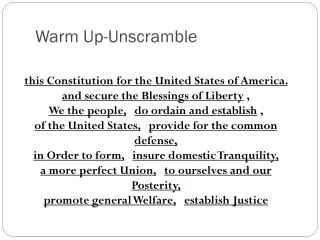
Warm Up-Unscramble this Constitution for the United States of America.and secure the Blessings of Liberty,We the people,do ordain and establish,of the United States,provide for the common defense,in Order to form,insure domestic Tranquility,a more perfect Union,to ourselves and our Posterity,promote general Welfare,establish Justice
Warm Up-Answer We the People of the United States, in Order to form a more perfect Union, establish Justice, insure domestic Tranquility, provide for the common defense, promote the general Welfare, and secure the Blessings of Liberty to ourselves and our Posterity, do ordain and establish this Constitution for the United States of America.
Popular Sovereignty • People have the right to rule • “We the People” • Voting and Elections
Rule of Law • Judicial Review • Impeachment • when President or Supreme Court Justice has broken the law • Majority of house to bring charges, 2/3 of senate to remove
Separation of Powers • Article 1 • Powers to the Legislative Branch • Article 2 • Powers to the Executive • Article 3 • Powers to the Judicial
Legislative Executive Judicial
Checks and Balances • L>E: impeachment, override veto, reject appointments and treaties • L>J: impeachment, reject appointments • E>L: veto (also head of party, “bully pulpit”) • E>J: appoint judges, pardon • J>E: declare actions unconstitutional • J>L: declare laws unconstitutional
Limited Government • Government may only do the things that people have given them the power to do • Article I, Sec 9- powers DENIED to Congress • Article I, Sec 10- powers DENIED to the States • Constitutionalism- • gov’tmust follow the law
Federalism • Enumerate (expressed) Powers • Implied Powers • Necessary and Proper/Elastic Clause • Reserved Powers • Full Faith and Credit Clause • Example Public Education
Federalism Continued • Concurrent Powers • Shared • Taxes, Crime, Punishment • Supremacy Clause • Supreme law of the land • Federal Gov’t > States