Mapping Frontiers: Exploring the Irish Border and Cross-Border Relations in Contemporary Europe
This program investigates the impact of the Irish border as a contemporary reality in Europe, focusing on historical perspectives, socio-economic costs of partition, and the evolution of cross-border relations. It aims to enhance understanding of borders, analyze partition consequences, and propose measures to improve relations. Key themes include comparative analysis with other global borders, the specifics surrounding the Irish border, and examining cross-border interactions since 1998. The initiative will involve workshops, publications, and public engagement to influence policy makers and foster cooperation.

Mapping Frontiers: Exploring the Irish Border and Cross-Border Relations in Contemporary Europe
E N D
Presentation Transcript
BACKGROUND Borders and border zones as a reality of life in contemporary Europe …
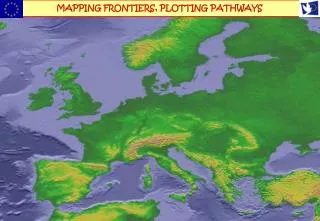
BACKGROUND and the Irish border as a new challenge: from four provinces … to two states
OBJECTIVES The programme will explore the border from a comparative historical perspective and look at efforts (especially after 1998) to counteract its more negative effects. It is designed to: • Improve our understanding of the nature of borders in general and of the Irish border in particular • Assess socio-economic and political costs of partition • Examine cross-border bodies, old and new • Propose measures to improve cross-border relations
APPROACH The programme will tackle three main themes: • Borders in comparative perspectivecomparison with other borders and frontiers zones within and outside Europe • The Irish border analysis of partition and its consequences for the two Irish states that appeared in 1921-22 • Cross-border relationsassessment of the degree of cross-border contact in contemporary Ireland and of the changing position since 1998
(1) BORDERS: COMPARATIVE There are many bases of comparison: • “Cold War” frontiers (Korea, China-Taiwan; Germany and Vietnam in the past) • Internal ethnic conflicts (Cyprus, Sri Lanka, Belgium) • Consequences of geopolitical realignment (Alsace-Lorraine, Tyrol, Schleswig) • New transfrontier issues (Basque Country, etc.)
(2) THE IRISH BORDER The evolution of the Irish border will be studied in detail, focusing on: • Partition as a mechanism for separating communities • “Cold-war” perspectives from Dublin and Belfast • The “Irish dimension” after 1972 • Negotiating a new North-South relationship
(3) CROSS-BORDER RELATIONS Here three major sub-themes or topics will be addressed: • The nature of the border • The impact of the border • Addressing the issue of the border
(3) CROSS-BORDER RELATIONS A. The nature of the border • The border and the two communities • The southern minority • The northern minority • The reality of life on the border
(3) CROSS-BORDER RELATIONS B. The impact of the border • Politics and political organisations (parties, elected members) • Public administration (civil services, education, health, etc.) • Communications (road, rail, air, sea; newspapers, radio, TV, etc.) • Economy (trade, industrial develop.) • Society, culture, religion, sports (island-wide organisation)
(3) CROSS-BORDER RELATIONS C. Addressing the issue of the border • Voluntary or non-state initiatives (Co-Operation Ireland etc.) • Public sector initiatives post-1972 • European dimension (INTERREG, Peace and Reconciliation Programme, etc.) • North-South implementation bodies post-1998 • Other forms of institutionalised public sector cooperation
OUTPUTS CONFERENCES AND MEETINGS • Regular workshops and round-table meetings • Periodic conferences and public events • Closing conference PUBLICATIONS • Regular working papers • Journal articles, book chapters, two books • Website PUBLIC IMPACT • Involvement of policy makers • Liaison with public
Research team (Belfast-Armagh): Elizabeth Meehan, Liam O’Dowd, Cathal McCall, Patrick McWilliams, James Anderson, Hastings Donnan, Andy Pollak, Robin Wilson
Research team (Dublin): John Coakley, Jennifer Todd, Etain Tannam, Cormac Ó Gráda, Kevin Howard, Kieran Rankin, John Bradley
CONTACTS: Dublin:+353-1-716 8670ibis@ucd.iewww.ucd.ie/ibis Belfast:+44-28-9097 5317mapping.frontiers@qub.ac.ukwww.governance.qub.ac.uk