Decadal variability
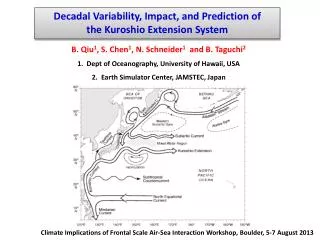
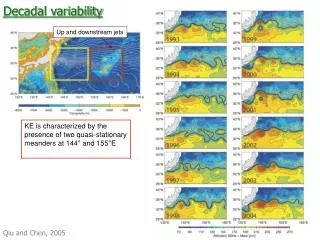
This research delves into the decadal variability of the Kuroshio Extension (KE) jet, characterized by two quasi-stationary meanders located at 144° and 155°E. Qiu and Chen (2005) investigate whether the observed decadal variability can be attributed to large-scale wind stress field forces. They utilize a 1½-layer reduced gravity model to analyze the ocean's response to surface wind forcing, supported by data from OFES, including SSH EOFs and regression maps. Their findings illustrate the complex interactions between SSH anomalies and the KE jet dynamics.

Decadal variability
E N D
Presentation Transcript
Decadal variability Up and downstream jets Qiu and Chen, 2005 KE is characterized by the presence of two quasi-stationary meanders at 144° and 155°E
Decadal variability Qiu and Chen, 2005 Can the observed decadal variability be explained by the forcing of the large-scale wind stress field?
Decadal variability 1 ½ layer reduced gravity model for the ocean response to surface wind forcing
SSH EOF’s 1 & 2 OFES ROMS
Regression maps (lags) SSH – PC 1
Regression maps (lags) SST – PC 1
Regression maps (lags) Propagation of SSH anomalies in the SW direction SSH – PC 2
Regression maps (lags) SST – PC 2
Zonal SSH EOFs SSH average zonally between 142°E-180° The first mode represents a north-south shift of the KE jet EOF 1: 52.98% EOF 2: 17.96% Taguchi et al, 2007 The second mode tracks very well with the strength of the KE jet Taguchi et al, 2007
Strength of Kuroshio (Taguchi et al. 2007; Qiu et al., 2005) Isolated as the zonal PC 2 of SSHa field between 142-180E Lag correlation between NPGO index and Kuroshio zonal PC2
Regression maps (lags) SSH – PC 2