Download
1 / 9
90 likes | 209 Vues
Learn the fundamentals of graphing, including how to create and label the Y-axis and X-axis, decide on appropriate intervals for data, and plot points using scatter plots. This guide also covers drawing the line of best fit to illustrate trends in data, as well as interpreting graphs to extract meaningful information, such as total travel distance. Whether plotting distance vs. time or examining weight changes over years, these skills are essential for effective data visualization and analysis.

E N D
Creating a graph Draw the y-axis on the vertical axis and the X-axis on the horizontal one Label what variable is on each of the axis and show units
Title graph using format y vs. x Distance vs. Time Distance (m) Time (s)
Decide on what intervals you will be using on each axis and write those in • Be sure that the intervals are even and appropriate to the measurements you have taken John’s Weight vs. Year
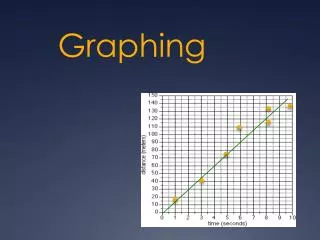
Plot the data points that you collected on the graph (Scatter plot) Draw the line of best fit(trend line) A line on a scatter plot which can be drawn near the points to more clearly show the trend between two sets of data. Line of Best Fit
You try!! 9 8 • Draw a line of best fit for the following scatter plot. 7 6 5 4 3 2 1 1 2 3 4 5 6 7 8 9
Plotting Points (x, y) • (3, 2) • (5, 3) • (3, -2) • (-4, 1) • (0,-1) • (-3, -5)
Interpreting Graphs • How many total miles did the car travel?
Works Cited • www.fccps.k12.va.us/GM/GMHS/faculty/harris/psnotes/physics/02graphing.ppt -