Download
1 / 26
260 likes | 383 Vues
This guide provides essential information about earthquakes, focusing on their relationship with tectonic plate boundaries, seismic wave analysis, and how these natural phenomena reveal insights about the Earth's interior. It explains the difference between primary (P) and secondary (S) waves, along with methods to find an earthquake's epicenter using arrival times of seismic waves. Additionally, it emphasizes the importance of emergency preparedness, including creating a safety plan, evacuation routes, and necessary supplies to ensure safety during an earthquake.

E N D
TECTONIC PLATES EARTHQUAKES HAPPEN AT TECTONIC PLATE BOUNDARIES
ANALYSIS OF SEISMIC WAVES HAVE RESULTED IN THE INFERENCE ABOUT EARTH’S INTERIOR S WAVES CANNOT PASS THROUGH THE LIQUID OUTER CORE
EARTHQUAKE SHADOW ZONES NO WAVES OCCUR BETWEEN 105º -140º S WAVES DISAPPEAR FROM 105º NEVER TO APPEAR AGAIN
CONVECTION CURRENTS IN THE ASTHENOSPHERE CAUSE THE PLATES TO MOVE IN DIFFERENT DIRECTIONS – LOOK AT ARROWS DIVERGING CONVERGING
SAN ANDREAS FAULT NORTH PACIFIC PLATE WEST SIDE MOVES NORTH NORTH AMERICAN PLATE EAST SIDE MOVES SOUTH EAST WEST SOUTH
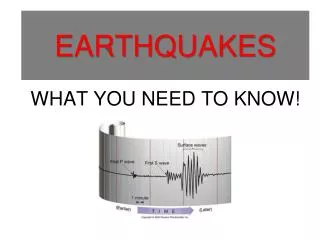
P WAVES • Primary waves (compression waves) vibrate parallel to the direction of movement. (push-pull like a slinky) • Travel faster than any other wave (6-8 km./s) • Travel through solids, liquids, and gases
S WAVE • Secondary wave (shear waves) vibrate side to side to the direction the wave is moving • Slower than P waves (4-5 kms./s) • TRAVEL THROUGH SOLIDS ONLY
What is an Epicenter? • A point on the surface of the Earth directly above the FOCUS of the earthquake. • The point within the Earth from which earthquake waves originate.
Use the data from the recording stations: • Station A: San Francisco, California P-Wave arrival 3:02:20 S-Wave arrival 3:06:30 What is the time difference between P and S wave arrivals? 4:10
Use the data from the recording stations: • Station B: Denver, Colorado P-Wave arrival 3:01:40 S-Wave arrival 3:05:00 What is the time difference between P and S wave arrivals? 3:20
Use the data from the recording stations: • Station C: Missoula, Montana P-Wave arrival 3:01:00 S-Wave arrival 3:03:00 What is the time difference between P and S wave arrivals? 2:00
Difference in arrival times: San Francisco: 4:10 Denver, Colorado: 3:20 Missoula, Montana: 2:00
TAKE A PIECE OF PAPER, AND MARK OFF THE DIFFERENCE IN ARRIVAL TIME 4:10 2800Km
MOVE THE PAPER UNTIL THE TWO TICK MARKS LINE UP WITH THE P AND S CURVES WHEN TICK MARKS LINE UP, GO STRAIGHT DOWN AND READ THE EPICENTER DISTANCE EPICENTER DISTANCE OF 2800 KM
EPICENTER DISTANCES San Francisco: 4:10 2,800 km Denver, Colorado: 3:20 2,000 km Missoula, Montana 2:00 1,100 km
Recording BoardDifference in arrival times: San Francisco: 41:0 2,800 km Line your compass up to the EXACT distance on the scale. Use the metric side (cm) beginning from zero. 0 3,000 2,000 4,000 5,000 1,000
Use your carefully set compass to draw a circle around each seismic station. . . . You've found a possible epicenter! Does this seem like a likely location for an earthquake to occur?
Emergency Preparedness Plan: • Duck and cover • Evacuation route and safe place to go to • Supply of clean water, food, blankets, flashlight, batteries, med.