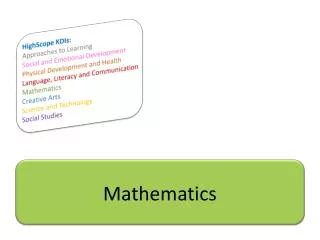
Enhancing Early Mathematics Development: Key Indicators and Strategies for Educators
This program aims to equip participants with the knowledge and skills to identify Mathematics Key Developmental Indicators (KDIs) and their components. Participants will learn to recognize the importance of rote counting as a foundation for math skills and explore strategies and materials to foster math learning in young children. Additionally, they will delve into understanding number words, counting, part-whole relationships, patterns, data analysis, shapes, spatial awareness, and measurement to support children's math development through engaging, hands-on activities.

Enhancing Early Mathematics Development: Key Indicators and Strategies for Educators
E N D
Presentation Transcript
Objectives Participants will be able to: • Identify the Mathematics Key Developmental Indicators • State the components of each individual Math KDI • Identify strategies and classroom materials that support children’s math learning
What is Math? • Have you seen adults get excited when children can rote count to high numbers? • What does the ability to rote count really say about young children’s math development? • What components are included in math development?
KDI 31: Number Words and Symbols Children recognize and use number words and symbols KDI 31: Number Words and Symbols Children: • Recognize and name numerals in their environment • Begin to write numbers • Understand that cardinal numbers (e.g., one, two , three) refer to quantity • Understand that ordinal numbers (e.g., first, second, last) refer to the order of things
KDI 32: Counting Children count things KDI 32: Counting Children: • Count using one-to-one correspondence • Understand that the last number counted means how many there are • Use comparison words (more, fewer, same) to compare quantities • Understand adding to and taking away
KDI 33: Part-Whole Relationships Children combine and separate quantities of objects KDI 33: Part-Whole Relationships Children: • Understand that a set of objects can be divided into parts • Understand that the parts can be combined into the whole
Were you able to identify the Number KDIs? • Which of these activities might be appropriate for children?
I See a Pattern Here… • What is patterning? • From your seat look for an example of a pattern in the room. Share with your table group
KDI 38: Patterns Children identify, describe, copy, complete, and create patterns KDI 38: Patterns Children: • Work with simple alternating patterns • Progress to more complex patterns
Developmental Sequence • Color • Shape • Size
Ah Ha! • Sometimes we can sabotage children’s patterning efforts by adding too many variables at one time! • Remember the developmental sequence of doing a patterning activity for small-group time: First color, then shape, then size!
When Children Pattern, They: • First, identify a pattern • Next, create their own pattern • Finally, extend or grow a pattern
So this is what patterning look like!?!
In table groups, collect data about something having to do with your breakfast today. • Once you’ve collected your data, share it in some way on the chart paper (e.g., a graph, a chart, or a table. What we Ate? Where we Ate? How Long it Took Us to Eat?
KDI 39: Data Analysis Children use information about quantity to draw conclusions, make decisions, and solve problems KDI 39: Data Analysis Children: • Collect, organize and compare information based on measureable attributes • Represent data in simple ways • Interpret and apply information in work and play
KDI 34: Shapes Children identify, name and describe shapes KDI 34: Shapes Children: • Recognize, compare and sort two- and three-dimensional shapes • Understand what makes a shape a shape • i.e., all triangles have 3 sides and 3 points • Transform shapes by putting things together and taking them apart
Shape Hunt Revisited • Circle • Rectangle • Triangle Did you know that this is the developmental sequence that children learn shapes?
More 2-D Shapes • Right Triangle • Isosceles Triangle
3-D Shapes • Sphere • Rectangular Prism • Cube • Cylinder • Cone
What Makes a Shape a Shape? • What are the specific attributes or properties that make up each shape?
Thinking About Shapes • After making your own shapes, discuss your assigned question in your table group. • Be ready to share your thoughts with the whole group.
Shape Pictures • Use the shapes to create your own “shape picture.” • Leave your shape picture in front of you to use for another activity.
KDI 35: Spatial Awareness Children recognize spatial relationships among people and objects KDI 35: Spatial Awareness Children: • Use position, direction and distance words to describe actions and the location of objects in the environment • Solve simple spatial problems in play • e.g., building with blocks, wrapping objects, doing puzzles
Heavy and Light • Bring something “heavy” and something “light” to your table. • In table groups, answer the following questions: • Who has the lightest object? • Who has the heaviest object? • Can an object be both heavy and light? • Put all of the objects from your table in order from heaviest to lightest.
KDI 36: Measurement Children measure to describe, compare and order things KDI 36: Measurement Children: • Use measurement terms to describe attributes • e.g., length, volume, weight, temperature, time • Compare quantities and order them • Same/different, bigger/smaller, more/less, heavier/lighter • Estimate relative quantities • e.g., whether something has more or less
Use the masking tape to make a tape line that is the same length as either you or your partner, then do the following: Measurement 1 • Use your pack of sticky notes to measure your tape line. Record your results. Measurement 2 • Use a dollar bill or a pencil to measure the same tape line. Record your results.
or • Which measuring method was easier? • Why was it easier? • What did you find out about measuring? • What steps (specifically) must you take in order to measure accurately?
KDI 37: Unit Children understand and use the concept of unit KDI 37: Unit Children: • Understand that a unit is a standard (unvarying) quantity • Measure using unconventional and conventional measuring tools • e.g., a block or a ruler • Use correct measuring procedures • Begin at the baseline and measure without gaps or overlaps
Can You Find the Math? • In pairs, read the anecdotal notes in your training booklet. • Identify the math KDI that each anecdote represents.
Strategies that Support Math Learning • Recognize and support children’s math-related play • Join in children’s math play as a partner • Describe or comment on children’s math-related play • Layer on math language
Strategies that Support Math Learning (cont.) • Investigate children’s math thinking by asking what and why questions • What do you think about…? • Why do you think that…? • Encourage children to make predictions • I wonder what would happen if...? • What would be different if…?
What would you say?What would you do? ?? ?? • With a partner, select 2 or 3 anecdotes. • Apply these strategies to your selected anecdotes. • Specifically, write down what you would say or do if you were the adult in the situation.
Wish List • Complete the Implementation Plan in the Training Booklet, indicating materials you would like to add to your classroom to support mathematics.