SlideServe
Menu
Préférences
© SlideServe · v2026

David Nesvorny David Vokrouhlicky (SwRI) Alessandro Morbidelli (CNRS)

nanji avatar
22 diapositives · 436 Views · Aug 21, 2014

Capture of Irregular Satellites during Planetary Encounters. David Nesvorny David Vokrouhlicky (SwRI) Alessandro Morbidelli (CNRS). Cassini image of Phoebe. Irregular Satellites.
David Nesvorny David Vokrouhlicky (SwRI) Alessandro Morbidelli (CNRS) - slide 1
01 / 22David Nesvorny David Vokrouhlicky (SwRI) Alessandro Morbidelli (CNRS)
1 / 17

Télécharger la présentation

David Nesvorny David Vokrouhlicky (SwRI) Alessandro Morbidelli (CNRS)
Une image / un lien ci-dessous est fourni (tel quel) pour télécharger la présentation

Politique de téléchargement : le contenu du site vous est fourni TEL QUEL pour votre information et votre usage personnel ; il ne peut être vendu, concédé sous licence ni partagé sur d’autres sites sans l’accord de son auteur.Le contenu vous est fourni TEL QUEL, pour votre information et votre usage personnel uniquement. Téléchargez la présentation en cliquant sur ce lien. Lors du téléchargement, si vous ne parvenez pas à télécharger une présentation, l’éditeur a peut-être supprimé le fichier de son serveur.Pendant le téléchargement, si vous ne parvenez pas à obtenir une présentation, le fichier a peut-être été supprimé par l’éditeur.

F I N

Plus de contenu associé

Transcription de la présentation
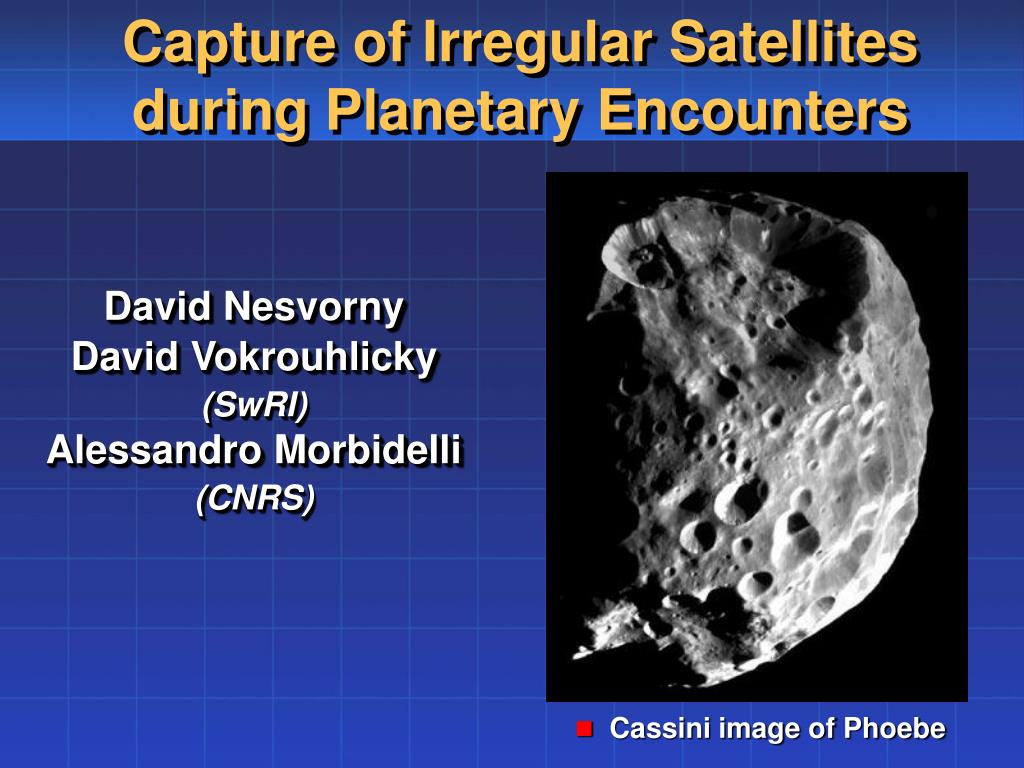
  1. Capture of Irregular Satellites during Planetary Encounters David Nesvorny David Vokrouhlicky (SwRI) Alessandro Morbidelli (CNRS) • Cassini image of Phoebe

  2. Irregular Satellites • 95 known objects: 54 at Jupiter, 26 at Saturn, 9 at Uranus, 6 at Neptune (excluding Triton)(Gladman, Sheppard, Jewitt, Holman and others) • 1-km to 340-km diameters • Colors ranging from ‘gray’ to ‘light red’ (Grav et al.) • Irregular satellites have large, eccentric and predominantly retrograde orbits • Origin distinct from the one of regular moons (which formed by accretion in a circumplanetary disk)

  3. Origin of Irregular Satellites • Capture from the circumsolar planetesimal disk (aerodynamic gas drag, planet’s growth and expansion of its Hill sphere, etc.) • All have one important drawback: formed IR satellites are dynamically removed later when planets migrate in the planetesimal disk (e.g., Beauge et al. 2002) • In the Nice model(planets migrate, Jupiter & Saturn cross 2:1, excited orbits of Uranus & Neptune stabilized by dynamical friction):any original populations of irregular satellites are removed during encounters between planets(Tsiganis et al. 2005)

  4. New model for Capture • We propose a new model: ‘Irregular satellites were captured during planetary encounters when background planetesimals were deflected into bound orbits around planets as a result of 3-bodygravitational interactions’

  5. Capture during Planetary Encounters • We performed 50 new simulations of the Nice model, ~20 successful runs produced correct planetary orbits

  6. Nice model: example simulation (seed1) • Neptune • Uranus • Saturn • Jupiter 2:1

  7. Capture during Planetary Encounters We performed 50 new simulations of the Nice model, ~20 successful runs produced correct planetary orbits Planetary orbits and state of the planetesimal disk were recorded during every planetary encounter

  8. State of the planetesimal disk recorded at the last encounter of the seed1 run Most orbits beyond ~30 AU are dynamically cold Encounter happens at ~19 AU Excited orbits in the encounter zone: <e>~0.2, <i>~10o

  9. Capture during Planetary Encounters We performed 50 new simulations of the Nice model, ~20 successful runs produced correct planetary orbits Planetary orbits and state of the planetesimal disk were recorded during every planetary encounter Typically several hundred planetary encounters

  10. Planetary encounters Distance In the seed1 run: 219 encounters betweenUranus and Neptune 3 encounters between Saturn and Neptune 1-3 km/s encounter speeds Speed

  11. Capture during Planetary Encounters We performed 50 new simulations of the Nice model, ~20 successful runs produced correct planetary orbits Planetary orbits and state of the planetesimal disk were recorded during every planetary encounter Typically several hundred planetary encounters but not enough disk particles to record captures directly Bulirsch-Stoer integrations, 3 million objects (clones of original disk particles) were injected into the encounter zone at each recorded encounter

  12. Capture during Planetary Encounters We performed 50 new simulations of the Nice model, ~20 successful runs produced correct planetary orbits Planetary orbits and state of the planetesimal disk were recorded during every planetary encounter Typically several hundred planetary encounters but not enough disk particles to record captures directly Bulirsch-Stoer integrations, 3 million objects (clones of original disk particles) were injected into the encounter zone at each recorded encounter Our model accounts for the encounter sequence where satellites are captured, removed or may switch between parent planets

  13. Capture during Planetary Encounters Will show in the following the results for the last 22 encounters between Uranus and Neptune in the seed1 run

  14. # of satellites captured at Neptune in the last 22 encounters in seed1 Generations of satellitescaptured during early planetary encounters do not contribute muchto the final population ~320 stable satellitescaptured around Neptunein this experiment(out of 3 million test particles) ~10-7-10-8 capture probability per one particle in the disk Lategenerations Early generations

  15. Orbit distributions of captured objects in the last 22 encounters in seed1 Satellites of Uranus Wide range of inclinationsand eccentricities Semimajor axis values up to ~0.25 AU Satellites of Neptune

  16. Comparison with orbits of known irregular moons Satellites of Uranus A good agreement for Uranus Two IR satellites of Neptune, S/2002 N4 and S/2003 N1, have a~0.32 AU Satellites of Neptune

  17. Comparison with SFD of known irregular moons Jupiter Saturn 35 Earth masses, Bernstein et al.SFD of present Kuiper belt, & our capture efficiency Planetary encounters producemore small irregular satellites than needed, their SFD is steeper Indicates that the SFD of the planetesimal disk may have been shallow during planetary encounters Uranus Neptune

  18. Conclusions Planetary encounters in the Nice model remove pre-existing irregular satellites and create large populations of the new ones Shallow SFD of planetesimals at 10-30 AUat the time when encounters happened; constraint on timing (early vs. LHB Nice models) Results consistent with spectroscopic obs. of IR moons that show no clear correlation between color and heliocentric distance

  19. Captures via Exchange Reactions • Observed large fraction of binaries in Kuiper Belt • Exchange reactions suggested by Agnor & Hamilton (2006)as an attractive model to capture Neptune’s Triton; proposed by H. Levison for irregular satellites • We have studied exchange reactions forirregular satellites via numerical simulations of the late phase of planet migration andvia millions of scattering experiments

  20. Distribution of encounter speeds between planets and planetesimals Speeds typically a few km/s To capture by exchange, orbit speed of the binary needs to be comparable or larger thanthe encounter speed Requires large, planetary-sizedmass of the binary

  21. Orbits of objects captured by exchange reactions 2 Mars-mass primaryand several million encounter experiments We varied binary’s semimajor axis, inclinationand orientation of its orbitrelative to the target plane Encounters taken from migration runs Good capture efficiency but produced orbits have large e or small a

  22. Conclusions Exchange reactions during binary-planet encounters require a planetary-sized primary Captured objects have very large eccentricities and/or small semimajor axis values Requires additional mechanism that can expand captured orbits (e.g., at Neptune, captured and tidally-evolving Triton may scatter stuff around,Cuk & Gladman 2005)