Download
1 / 13
130 likes | 264 Vues
Explore the rich legacy of Ancient Greece, where the earliest forms of democracy flourished over 2500 years ago among city-states like Athens and Sparta. Discover how these political units, characterized by their acropolises and surrounding walls, fostered unique cultural identities. Learn about the Golden Age of Greece, marked by remarkable achievements in philosophy, literature, and the arts. Follow Alexander the Great's conquests that unified Greece and spread its culture across vast territories, culminating in the Hellenistic era, a fusion of Greek and local cultures.

E N D
The Greeks were the earliest people to use voting, over 2500 years ago.
Greek City-States • Political units made up a city and it’s surrounding lands • In the middle of the city-state/fortress or hill called an acropolis (included temples and other public buildings • City-states were surrounded by high walls • 2 city states: Athens and Sparta • People considered themselves Members of their city-state, not Greeks Athens V.S. Sparta (brains versus brawn)
Athens V.S. Sparta • Athens • __________________ • __________________ • __________________ • __________________ • __________________ • __________________ • __________________ • Sparta • __________________ • __________________ • __________________ • __________________ • __________________ • __________________ • __________________
Greek Colonies • Outposts of some city-states • Now modern cities; Naples, Italy and Marseille, France • Traded goods and shared ideas
The Golden Age of Greece (500-300BCE) A period of great achievement in Greece. A time of great philosophers, writers, scientists and artists.
Growth in Greek Power • City-states banded together to fight off enemies of Greece. • Around 500 BCE, Persia (powerful empire in central Asia) invaded Greece. • Persian army was huge and well trained. • Greeks, led by Athens, defeated Persian army. • 10 years later, Persia invaded again and was again defeated.
Athenian Culture • Pericles, an Athenian leader in the 400s BCE, encouraged creation of great works • Ex: The Parthenon temple
Athenian Democracy IN 6.2.2 • Leaders like Pericles were elected • Power was in the hands of the people • Ideas were presented to the assembly • A group of free men who took part in the decision making. • Ideas were often argued and debated publicly. This was the world’s first democracy which all others were modeled.
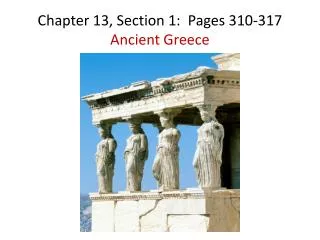
Architecture and Art • Temples, buildings and sculptures done in marble • Statues were created to look realistic and lifelike.
Science, Philosophy, and Literature • Scientists studied biology and medicine. • Greek scholars made great advancements in math and astronomy. • Philosophers, or thinkers wanted to figure out what made people happy -Socrates, Plato and Aristotle. • Greeks were writers of great stories, poems and plays.
Decline of the City-States • War between rivals: Sparta and Athens -went on for years, Sparta won -destroyed several city-states in Greece -thousands of people killed -weakened Greek civilization -Allowed a foreign conqueror to invade and take over Greece. Alexander The Great
Alexander’s Conquests The Empire of Alexander • Conquered Greece in 330s BCE • From Macedonia • Unified Greece under a single ruler for the first time. Spread of Greek Culture • Alexander would conquer lands and encourage Greeks to move there • Built cities throughout his empire; Alexandria • Greek culture spread and blended with other cultures • Hellenistic-meaning “Greek-like” 336 BCE invaded and conquered all of Greece 334 BCE after conquering Greece, set out to create a huge empire Extended his empire to central Asia and Egypt 325 BCE died at the age of 33 of an illness