Diverse Substrate Types for Aquatic and Terrestrial Ecosystems
Understanding the various substrate types is crucial for studying aquatic and terrestrial ecosystems. Substrates can be categorized into aquatic (e.g., rheophytic and floating), terrestrial (e.g., mineral, gravel, sand, clay), epiphytic (e.g., epiphyllous and corticolous), and semi-terrestrial (e.g., peatlands). Each substrate type has unique characteristics, such as attachment methods and moisture levels, influencing the growth of different species. This knowledge aids in conservation efforts and ecosystem management by providing insights into habitat requirements.

Diverse Substrate Types for Aquatic and Terrestrial Ecosystems
E N D
Presentation Transcript
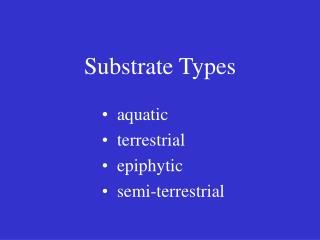
Substrate Types aquatic terrestrial epiphytic semi-terrestrial
aquatic • rheophytic • on mineral substrate ARM • on organic substrate ARO • stagnant • floating ASF • attached ASA • littoral • splashed by waves ALW • tropohydrophytic • on mineral substrate ATM • on organic substrate ATO
terrestrial • mineral • gravel or rock (> 2 mm) TMR • sand (0.05 - 2.0 mm) TMS • clay or silt (< 0.05 mm) TMC • organic • litter TOL • humus TOH
epiphytic • epiphyllous EPH • corticolous • on bark, growing vertically ECV • on bark, growing horizontally ECH • on twigs ECT • lignicolous • on wood, growing vertically ELV • on wood, growing horizontally ELH
semi-terrestrial • peatlands • on peat SPG • peat forming SPF