
Hypothesis
E N D
Presentation Transcript
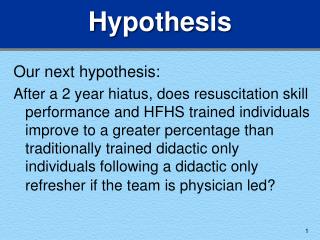
Hypothesis Research Methods Sport and Exercise Science
Grading Criteria • Describe (P6)two contrasting quantitativedata analysis techniques used in the sport and exercise sciences using an example of Microsoft Excel calculations & print screens: • T Test • Pearson’s Correlation Coefficient • (D) For 2 selected research-based examples, justify (M4) the most appropriate research design and techniques (Null, Alternate & Directional Hypotheses) for quantitative data collection and data analysis such as: • Pre & Post Test Design: Fitness test result before and after training programmes • Comparative Design: Relationship between two fitness tests e.g. BMI and Resting heart rate
What is a hypothesis • A hypothesis is a useful TESTABLE statement that proposes some explanation to an event • A hypothesis may include a prediction • However a hypothesis is NOT a theory
When would it be used? • The key word is Testable. • You would perform a test on two variables and how they might be related • Hypothesis is usually based on some previous observation such as your HR increases when you exercise • Are the two events connected? • How are they connected? • Task: Think of two variables that may be connected in Sport and Exercise Science and give 3 examples.
Hypothesis • A formal hypothesis contains 2 variables one is • Independent and the other • Dependent • The independent variable is the one you, the "scientist" control • the dependent variable is the one that you observe and/or measure the results.
Task • Question: What effect does exercise have on heart rate? • What is your hypothesis? • Which is the dependent and independent variable and why? • Exercise would be the independent variable • Heart rate would be dependent variable
Null or Alternate • nullhypothesis(H0): typically that there is no effect • Alternate hypothesis (H1): typically that there is an effect, or that there is an effect of a particular sign • Task • Using heart rate and exercise write down individually, the null and alternate hypothesis.
Types of hypothesis: T TEST • Null hypothesis – There will be no significant difference in heart rate following a 2km run at a pace of 6km/h. • Alternative hypothesis – There will be a significant difference in heart rate following a 2km run at a pace of 6km/h. • Directional hypothesis – There will be no significant increasein heart rate following a 2km run at a pace of 6km/h. (can be increase or decrease)
Hypothesis: Correlations • Null hypothesis – There will be no relationship between resting heart rate and BMI. • Alternative hypothesis – There will be a relationship between resting heart rate and BMI. • Directional hypothesis – There will be a positive relationship between resting heart rate and BMI. • (can be positive or negative)