The Journey of Light: From Classical Physics to Electromagnetic Waves
50 likes | 181 Vues
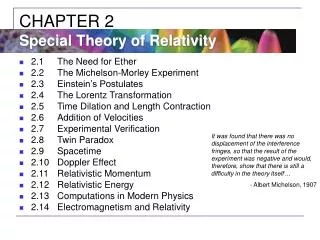
This exploration of light delves into classical physics and the transition to modern theories involving electromagnetic waves. The speed of light, a constant 186,000 miles per second, remains unchanging in all inertial frames, a fact evidenced by the Michelson-Morley experiment that found no expected motion of Earth through the supposed luminiferous ether. This study considers the properties of waves, the medium required for their propagation, and the implications of light's nature, challenging traditional notions of absolute motion and the structure of the universe.


The Journey of Light: From Classical Physics to Electromagnetic Waves
E N D
Presentation Transcript
CLASSICAL PHYSICS Light: Into the modern era • Electromagnetic waves • Wave media • Michelson & Morley
L I G H T Electric & Magnetic Vibrations `Electromagnetic Waves’ All travel at the same speed: 186,000 miles each second
Examples of Waves Waves -> Medium (what vibrates?)
Name given to purported medium of light waves • Must fill universe (we see light from stars) • Must have no viscosity (planets do not slow down) • Must be very stiff (light waves travel very fast) • …. in summary ????? Luminiferous Ether ?????? BIZARRE BIG PROBLEM Could define Absolute Motion relative to the Ether…
Michelson-Morley Speed of light same in all directions !!! experiments fail to detect motion of the Earth in Ether • Speed of light independent of • Inertial Reference Frame !!!