Key Concepts in Cost Analysis and Optimal Pricing Strategies
This chapter examines essential principles of cost analysis, emphasizing the significance of differential costs while ignoring fixed costs across options. It highlights the importance of opportunity costs and provides practical examples such as starting a business with calculated revenues, expenses, and economic profit. The content also addresses optimal pricing strategies for demand, marginal costs, and the relationship between demand and average costs. Finally, it outlines the shut-down rules, guiding firms on when to continue operations or cease production based on price conditions.

Key Concepts in Cost Analysis and Optimal Pricing Strategies
E N D
Presentation Transcript
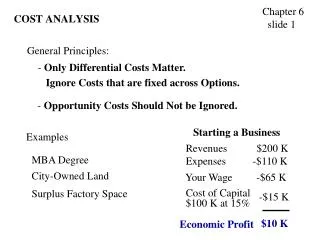
Chapter 6 slide 1 COST ANALYSIS General Principles: - Only Differential Costs Matter. Ignore Costs that are fixed across Options. - Opportunity Costs Should Not be Ignored. Starting a Business Examples Revenues $200 K Expenses -$110 K MBA Degree City-Owned Land Surplus Factory Space Your Wage -$65 K Cost of Capital $100 K at 15% -$15 K $10 K Economic Profit
6.2 ORDERING A BEST SELLER Demand: P = 24 - Q MC = $12 per book MR = 24 - 2Q = 12 Q = 6 hundred, P = $18 Cont. = (18 - 12)(600) = $3,600. A. Find optimal Q and P. MC = 12 + 4 (Opp Cost) Q = 4 hundred, P = $20. Cont. = (20 - 16)(400) = $1,600. B. Suppose average book earns $4 and shelf space is limited. MC = 4 + 6 (Opp Cost) MR = 18 - 4Q = 10, Q = 2 hundred, P = $14. Cont. = (14 -16)(200) + (6 - 12)(200) = -$1,600. C. Suppose demand falls to P = 18 - 2Q. How many of the 400 books should the store sell and how many should it return for $6 each?
AC MC 6.3 Example: MC = Wage/MPL COST ANALYSIS Short-Run Cost Behavior Diminishing Marginal Productivity leads to Increasing MC. W = $12/Hr, MPL = 4/Hr then MC = $3/unit
SAC1 SAC2 SAC3 LONG-RUN COST 6.4 The shape of LR average cost depends upon returns to scale. Flat LAC reflects Constant Returns to Scale. With plant fixed, SAC is U-shaped and lies above LAC. Constant LAC reflects Constant Returns to Scale.
6.5 OPTIMAL OUTPUT In either case, the firm’s Optimal output occurs where: MR = MC Low Demand versus High Demand MR MC Demand AC P* MR Q* Q*
P* Q* 6.6 THE SHUT-DOWN RULE 1. In the long run, the firm should shut down when: P < AC. 2. In the short run, the firm should produce Q* because: P > AVC. AC MC AVC MR Demand