Understanding Density: Measurement and Calculation of Mass per Volume
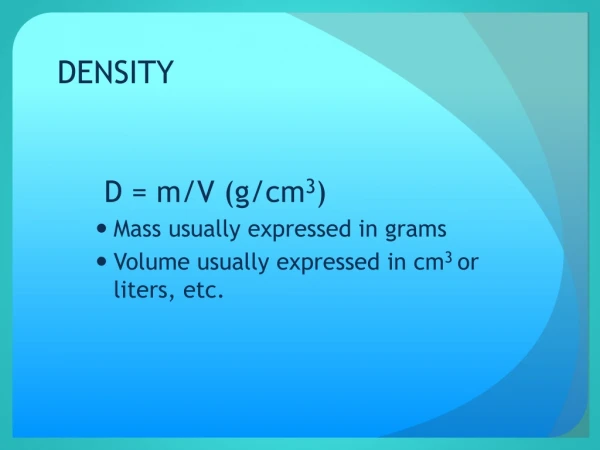
Density is a key property that measures how much mass is contained in a specific volume of an object. It compares the amount of "stuff" inside an object to its size. Density is calculated using the formula Density = Mass/Volume (in g/cm³). For example, the density of water is 1 g/cm³. An object will sink in water if its density is greater than 1 g/cm³ and float if it is less. This principle also applies to liquids, where more dense liquids sink and less dense ones rise. Learn how to determine density by calculating it based on mass and volume.

Understanding Density: Measurement and Calculation of Mass per Volume
E N D
Presentation Transcript
Density • Density – measure of how much mass is contained in a given volume • Amount of ‘stuff’ inside an object compared to how big it is
What’s more dense? • Foam roller or steel bar? • Baseball or hacky sack?
Calculating Density • Density = Mass / Volume (mass divided by volume) • Density = g/cm3 • Density of water = 1 g/cm3 • How do I determine if something sinks or floats in water?
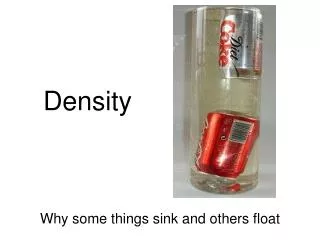
Sink or Float? • If the density is greater than water (>1 g/cm3), object will sink • If the density is less than water (<1 g/cm3 ), object will float
Density of Liquids • More dense liquids sink, less dense liquids rise Youtube Example
Calculating Density • Remember when you found the mass and volume of those 4 blocks earlier this week? Now calculate their density. • Iron: • Brass: • Aluminum: • Lead: