Harnessing Solar Energy: Understanding Photosynthesis Process
Learn about energy flow in living systems, compare autotrophs & heterotrophs, and the role of ATP in metabolism. Discover how sunlight energy is converted into chemical energy through photosynthesis stages, and factors affecting the process. 8

Harnessing Solar Energy: Understanding Photosynthesis Process
E N D
Presentation Transcript
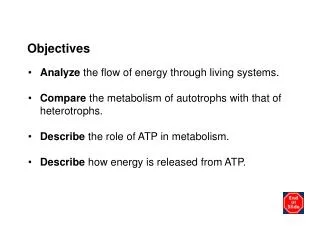
Objectives • Analyze the flow of energy through living systems. • Compare the metabolism of autotrophs with that of heterotrophs. • Describe the role of ATP in metabolism. • Describe how energy is released from ATP.
Energy in Living Systems • Directly or indirectly, almost all of the energy in living systems needed for metabolism comes from the sun.
Metabolism – using energy to build or break down molecules. • Photosynthesis – process of converting light energy into chemical energy. • If…. • Use energy from sunlight…. • Or… • Energy from chemical bonds…. • ….to make organic compounds (ex sugar), you are an autotrophs.
If…. • ….get energy from consuming organic compounds.… • ….Heterotroph • Most organisms convert the organic compounds to energy by cellular respiration.
What energy do cells want? • Energy released from food. • Some as heat. • Most stored temporarily in molecules of ATP. • ADENOSINE TRIPHOSPHATE • Portable energy “currency” inside cells. • ATP delivers energy wherever needed in a cell.
Chapter 5 Breakdown of Starch
ATP • Energy in bonds holding phosphates together. • Energy released when bonds broken. • ATP (triphosphate) becomes ADP (diphosphate). H2O + ATP ADP + P + energy
Objectives • Summarize how energy is captured from sunlight in the first stage of photosynthesis. • Analyze the function of electron transport chains in the second stage of photosynthesis. • Relate the Calvin cycle to carbon dioxide fixation in the third stage of photosynthesis. • Identify three environmental factors that affect the rate of photosynthesis.
Using the Energy in Sunlight The Stages of Photosynthesis • Stage 1 Energy captured from sunlight. • Stage 2 Light energy chemical energy • ATP, NADPH • Stage 3 Chemical energy (ATP, NADPH) powers formation of organic compounds (sugars, starches) • Uses CO2
Using the Energy in Sunlight • Photosynthesis Equation CO2 + H2O C6H12O6 + O2 Carbon dioxide water sugars oxygen gas 6CO2 + 6H2O C6H12O6 + 6O2 Carbon dioxide water sugars oxygen gas
Stage One: Absorption of Light Energy • Sunlight contains all wavelengths (colors) of visible light • ROYGBIV
Pigments • Light-absorbing pigments capture light. • High quantities in cells in leaves • Chlorophyll - primary pigment • absorbs mostly blue, red • reflects green (thus leaf is green) • 2 types • chlorophyll a • chlorophyll b
Where does it happen? • Plant cells in leaves • Inside plant cell: chloroplast • Inside chloroplast: thylakoids
Carotenoids • Secondary pigment • Fall leaf colors • Fruit, veggie, flower colors • Absorb diff’t light wavelengths • More light for photo
Production of Oxygen • Pigments in disk-shaped thylakoids. • Sunlight excites electrons in chlorophyll. • Excited electrons leave chlorophyll. • Must be replaced. • H2O split by thylakoid. • Replacement electrons • H+ ions • O, combine to form O2 gas.
Stage Two: Conversion of Light Energy • Excited electrons used to make ATP/NADPH. • Excited electron jumps into molecule in thylakoid membrane. • Passed through series of molecules in membrane. • Called electron transport chain.
Electron Transport Chains • 2 diff’t chains • One makes ATP • One makes NADPH • NADPH used to make carbon-hydrogen bonds in sugar.
Chapter 5 Section 2 Photosynthesis Electron Transport Train
Stage Three: Storage of Energy • Carbon atoms from CO2 used to make sugar/starch. • Process called Calvin Cycle.
Calvin Cycle • Series of enzyme-assisted chemical reactions: Step 1 Each CO2 added to a 5-carbon compound by an enzyme. Step 2 Splits into two 3-carbon compounds. Step 3 One 3-carbon sugars used to make organic energy-storing compounds. Step 4 Other 3-carbon sugars used to regenerate initial 5-carbon compound, completing the cycle.
Summary • Light-Dependent Reactions – use sunlight and H2O, makes ATP/NADPH and O2 • Calvin Cycle – uses ATP/NADPH and CO2, makes sugar
Factors that Affect Photosynthesis • Various environmental factors. • Rate increases as light intensity increases. • Most efficient within a certain range of temperatures. • Cold temp’s destroy chlorophyll.
Cellular Respiration – Chap 9Objectives • Summarize how glucose is broken down in the first stage of cellular respiration. • Describe how ATP is made in the second stage of cellular respiration. • Identify the role of fermentation in the second stage of cellular respiration. • Evaluate the importance of oxygen in aerobic respiration.
Chapter 5 Cellular Energy • Most ATP made with O2 – aerobic. • Some ATP made w/out O2 – anaerobic.
Chapter 5 • Cellular respiration – harvesting energy from organic compounds (usually glucose). C6H12O6 + 6O26CO2 + 6H2O + energy glucose oxygen gas carbon dioxide water ATP
Chapter 5 Stages • Stage 1 - Glucose pyruvate (releases small amount of ATP / NADH). • Stage 2 • O2 present: pyruvate, NADH LOT’S ATP • O2 absent: pyruvate lactate or ethanol, CO2.
Chapter 5 Section 3 Cellular Respiration Cellular Respiration
Chapter 5 Stage One: Breakdown of Glucose Glycolysis • Glycolysis – breakdown of glucose. • H atoms given to NAD+, forming electron carrier NADH. • 2 ATP’s made
Chapter 5 Glycolysis
Stage Two: Production of ATP • When O2 present • Pyruvate acetyl-CoA • Acetyl-CoA Krebs Cycle 2 ATP • Krebs Cycle – produces electron carriers
Stage Two: Production of ATP • When O2 present • Pyruvate acetyl-CoA • Acetyl-CoA Krebs Cycle 2 ATP • Krebs Cycle – produces electron carriers • Electron carriers electron transport chain up to 34 ATP
Electron Transport Chain • Movement of electrons create concentration gradient of H+ ions. • Movement of H+ ions back across membrane through ATP Synthase. • Water wheel • UP TO 34 ATP MADE!!!