Adaptive Robust Control for Dual Stage Hard Drives: Innovations and Strategies
90 likes | 242 Vues
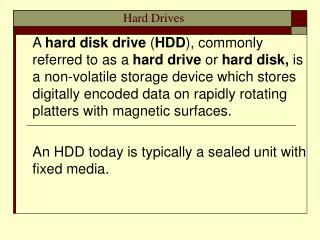
This work presents the application of adaptive robust control in dual-stage hard drives, focusing on optimizing performance, ensuring stable operation, and managing parametric uncertainties. Key control strategies discussed include bang-bang control, proximate time servo techniques, and adaptive control laws tailored to handle nonlinearities effectively. The evolution of hard drives from the 1950s to modern-day innovations is explored, including historical milestones and advances in technology. Emphasis is placed on transient performance and the framework established by Bin Yao for robust control in complex systems.


Adaptive Robust Control for Dual Stage Hard Drives: Innovations and Strategies
E N D
Presentation Transcript
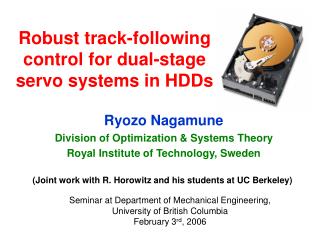
in GOD we trust Adaptive Robust ControlForDual Stage Hard Drives استاد راهنما :جناب آقای دکتر حمید تقی راد Dr. Hamid D. Taghirad هادی حاجی اقراری دانشجوی کارشناسی ارشد مهندسی برق –کنترل دانشگاه خواجه نصیرالدین طوسی H.H.Eghrary MS Student of Electrical Engineering K.N.Toosi Univ.
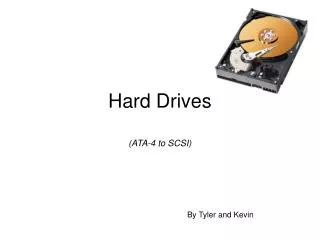
Hard Disk Derives • 1950 ERA 110 1200 RPM • 1956 RAMAC 350 (5 MBite, 50 Disk ,24 inch , 220kg) • 1965 (First Linear Voice Coil Actuator) • 1973 Winchester 3340by IBM • 1997 (7200 RPM by SeaGate) • 1997Cheetah X15 (15000 RPM by SeeGate)
Desired Performance • Transient Performance • Final Tracking
Control Strategies • Mode Switching Control • Bang Bang Control • Proximate Time Servo (PTS) • Proximate Time Optimal Servo (PTOS) • Repetitive Control • Adaptive Robust Control • Transient Perormance • Final Tracking • Parametric Uncertainity • Uncertain NonLinearities
Adaptive Robust Control • The General Theoretical Framework is Recently • Formalized by “Bin Yao”. • Parametric Uncertainty • Uncertain Nonlinearities • Certain Robust Control Laws are • Used to handle the Uncompensated • Uncertain Nonlinearities effectively • for High Performance. • Online Parameter Adaptation • is tilized to Reduce the Effects of • Various Parametric Uncertainty.
Single Stage HDD Head *Dual Stage HDD Head Control By Adaptive Robust Control*