Download
1 / 3
30 likes | 148 Vues
This overview explores the evolution of atomic theory from ancient philosophy to modern science. It delves into early ideas by Democritus and Leucippus, who proposed that matter consists of indivisible atoms, contrasting sharply with Aristotle’s qualitative view of the cosmos, which emphasized continuous matter and the four classical elements. We also examine John Dalton's atomic model, which revolutionized our understanding by introducing the concept of atoms as fundamental units of matter. The progression from qualitative to quantitative approaches marks a significant shift in scientific thought.

E N D
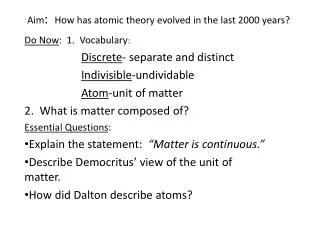
Aim: How has atomic theory evolved in the last 2000 years? Do Now: 1. Vocabulary: Discrete- separate and distinct Indivisible-undividable Atom-unit of matter 2. What is matter composed of? Essential Questions: Explain the statement: “Matter is continuous.” Describe Democritus’ view of the unit of matter. How did Dalton describe atoms?
Aim: How has atomic theory evolved in the last 2000 years? • How did Aristotle think of science? • Why are his writings largely qualitative, not quantitative? • Describe his view of the cosmos (universe and our place in it.) • State and describe his five “elements” • How do atomists explain the world as opposed to Aristotle? • Describe Democritus’ and Leucippus’ view of what matter is composed of. • How did Dalton describe atoms?
Aim: How has atomic theory evolved in the last 2000 years? • Essential Questions: • Explain the statement: “Matter is continuous.” • Describe Democritus’ view of the unit of matter. • How did Dalton describe atoms? • How was Dalton’s work different from that of the ancient Greek philosophers? • “Each atom of an element is identical to every other atom of that element. Elements are composed of atoms which are identical in mass.” True or false? Explain.