Understanding Solutions: Molarity, Composition, and Properties
In this lesson, we explore solutions and their components, focusing on solute and solvent definitions. We delve into molarity calculations and percent composition analysis, emphasizing practical examples like HCl, NaOH, and sugar solutions. Students will learn to identify solute and solvent, compute molarity, and derive grams from given molarity. Activities include discussions, problem-solving, and homework assignments targeted at reinforcing these concepts. By the end of the lesson, students will understand how to measure concentration and evaluate the properties of various solutions.

Understanding Solutions: Molarity, Composition, and Properties
E N D
Presentation Transcript
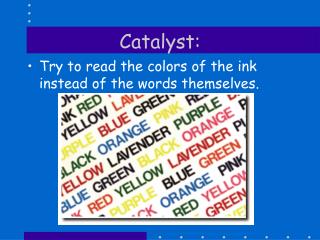
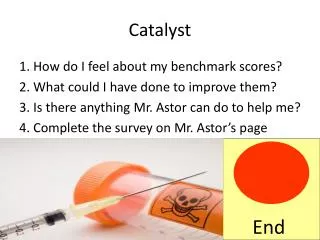
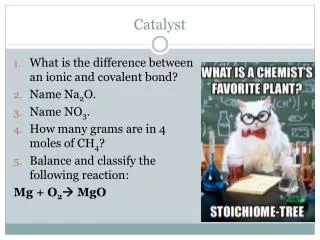
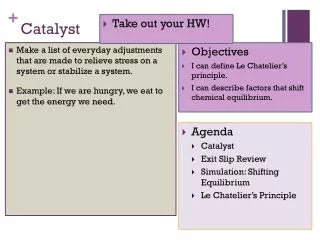
Catalyst End
Justify – TPS • Why did the cup you picked taste the strongest? What was different about it from the other cups?
Today’s Learning Targets • LT 3.5 – I can identify the solute and solvent in a given solution. • LT 3.6 – I can calculate the molarity and percent composition of a solution and discuss what the final concentration indicates. • LT 3.10 – I can analyze a substances molarity and determine the number of grams of a compound that are contained within a solution.
I. Solute and Solvent • The solventis the substance in which the solute is dissolved and is primary ingredient in a solution. • The soluteis the substance that is dissolved in the solvent.
II. Solute and Solvent • Water is the universal solvent. • If ever there is a solution that is water and another compound, then the solvent is always water.
I. Concentration • The concentration of a solution is the amount of a particular substance in a given quantity of solution.
II. Molarity • Molarityis a concentration unit of a solution expressed as moles of solute dissolved per liter of solution.
Class Example • I have 72 g of HCl that I dissolved in 4 L of solution. What is the molarity of this final solution?
Table Talk • In order to torture this gummy bear you need you make a solution of KClO3 you dissolve 1,220 g of KClO3 in 1 L of water. What is the molarity of your final solution?
Question 1 • You have a solution that is sugar dissolved in water. What is the solute in this solution?
Question 2 • You have a solution of naphthalene dissolved in methanol. What is the solvent?
Question 3 • You have 82 g of NaOH and you dissolve it in 4 L. What is the molarity of the solution?
Question 4 • You have 52 g of H2SO4 dissolved in 0.5 L. What is the molarity of the solution?
Question 5 • You have 52 g of CaCl2 dissolved in 0.1 L. What is the molarity of the solution?
I. Hold Up! We Can Work in Reverse • We can work backwards if we have a molarity and volume of solution. • From this we can determine both the moles and mass of our solute Molarity of the solution Molar Mass of solute
Class Example • If you have a 3 L of a 0.6 M solution of AgNO3, then what mass of AgNO3 is contained in this solution?
Table Talk • If all the water in 430 mL of a 0.45 M NaCl solution evaporates, what mass of NaCl remains?
I. Percent Composition • Percent compositionconveys the concentration in terms of percent of solute in a solution.
Class Example • A 4 g sugar cube (Sucrose: C12H22O11) is dissolved in a 350 g of water. What is the percent composition by mass of the sugar solution that is created?
Table Talk • You have 5 moles of NaCl and you dissolve this in 500 g of water, what is the concentration of this solution in terms of percent composition?
Connect 4 • With a partner you will be using the connect 4 sheet to practice problems. • Silently read through the directions on the sheet in front of you
Closing Time • Homework 3.6 due Tuesday/Wednesday