Download
1 / 8
80 likes | 198 Vues
This lesson aims to clarify the Law of Constant Composition, established by Joseph Louis Proust, which states that a given compound always contains the same proportion by mass of its constituent elements. We will explore John Dalton's Atomic Theory, which includes key principles about atoms, elements, and compounds. You will learn how to write chemical formulas representing compounds accurately, with attention to element symbols, subscripts, and the order of elements. Engage in exercises to strengthen your understanding of molecular composition, including real-life examples like glucose and aspirin.

E N D
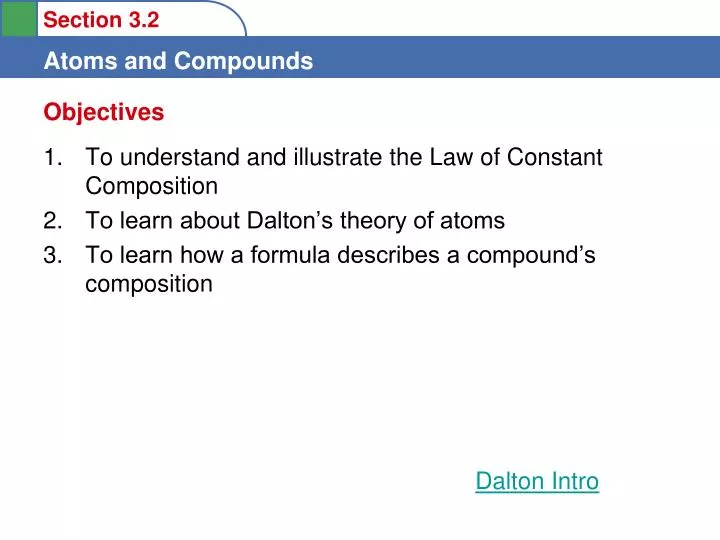
Objectives • To understand and illustrate the Law of Constant Composition • To learn about Dalton’s theory of atoms • To learn how a formula describes a compound’s composition Dalton Intro
A given compound always contains the same proportion by mass of the elements of which it is composed. • A mixture can have variable composition but the composition of a compound is fixed • Does this give us a clue about the nature of matter? Law of Constant Composition (1799 Joseph Louis Proust)
Dalton’s Atomic Theory (John Dalton 1766-1844) • Dalton’s Atomic Theory states: • All elements are composed of atoms • All atoms of a given element are identical • Atoms of different elements are different • Compounds consist of combinations of atoms of different elements • Atoms are not created or destroyed in a chemical reaction You have 90 seconds to memorize these 5 parts of the theory!!
Formulas of Compounds • A compound is represented by a chemical formula in which the number and kind of atoms present is shown by using the element symbols and subscripts. • Example: the simple sugar, glucose
Put your notes away and write a set of rules for how to write a formula of a compound. Be as complete as you can be using what you have learned throughout your course
B. Formulas of Compounds • Each atom present is represented by its element symbol. • The number of each type of atom is indicated by a subscript written to the right of the element symbol. • When only one atom of a given type is present, the subscript 1 is not written. • Write a metallic element first if present (MgCl2) • Write the central atom of a molecule first (PCl5) • Write Carbon first and Hydrogen second for an organic molecule (C6H12O6)
Formulas of compounds • Write the formulas for the following compounds: • A phosphorus atom bonded to three chlorine atoms • A molecule containing two boron atoms and six hydrogen atoms • A compound containing one calcium atom for every two chlorine atoms • Four hydrogen atoms bonded to a single carbon atom • A compound containing two iron atoms for every three oxygen atoms • A molecule of aspirin (acetylsalicylic acid – four oxygen atoms, eight hydrogen, nine carbon atoms)
Aspirin, acetylsalicylic acid, C9H8O4 Aspirin in Motion Element Hangman