Innovative Use of Dynamic Mechanical Analysis (DMA) for Asphalt Evaluation
Explore the versatility of Dynamic Mechanical Analysis (DMA) over the Bending Beam Rheometer (BBR) for cold temperature testing of asphalt concrete and binders. Analyze stiffness and relaxation properties at -18°C using a specific force and data variation criteria. Research conducted by Craig Vindedahl, Clayton Cloutier, and Gaven Kobes under Dr. Konstantin Sobolev with Co-Advisor Justin Flickinger.

Innovative Use of Dynamic Mechanical Analysis (DMA) for Asphalt Evaluation
E N D
Presentation Transcript
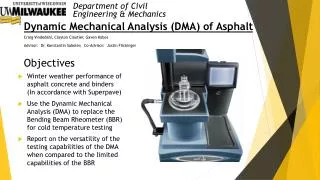
Department of Civil Engineering & Mechanics Objectives Dynamic Mechanical Analysis (DMA) of Asphalt Craig Vindedahl, Clayton Cloutier, GavenKobes Advisor: Dr. Konstantin Sobolev, Co-Advisor: Justin Flickinger • Winter weather performance of asphalt concrete and binders (In accordance with Superpave) • Use the Dynamic Mechanical Analysis (DMA) to replace the Bending Beam Rheometer (BBR) for cold temperature testing • Report on the versatility of the testing capabilities of the DMA when compared to the limited capabilities of the BBR
Approach/Methodology • Measure stiffness and relaxation properties • 12.7mm x 5.6mm x 60mm • Temperature of -18oC • 6 Newton force ramped at 0.001 N/min for 5 minutes • Data was required to be 5% or less coefficient of variation to show a correlation • . • .