Comparative Analysis of Quality Factor in PMMA-Coated Toroidal Devices Under Varying Conditions
This study involves a detailed comparison of the calculated quality factor (Q) with experimental measurements for PMMA-coated toroidal devices. Conducted by H-S. Choi, the experiments assessed the effects of varying wavelengths (850nm, 980nm) and film thicknesses (0-100nm) while maintaining consistent input power. The findings highlighted a consistent decrease in Q factor with increasing film thickness for both wavelengths. Additionally, the research noted that experimental Q values approached theoretical predictions but were affected by factors such as surface roughness. Future work will include further testing and exploration of PS materials.

Comparative Analysis of Quality Factor in PMMA-Coated Toroidal Devices Under Varying Conditions
E N D
Presentation Transcript
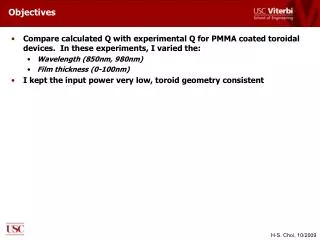
Objectives • Compare calculated Q with experimental Q for PMMA coated toroidal devices. In these experiments, I varied the: • Wavelength (850nm, 980nm) • Film thickness (0-100nm) • I kept the input power very low, toroid geometry consistent H-S. Choi, 10/2009
Objective 1: 850nm measurements Increasing film thickness 0 nm 20nm 50nm Decreasing Q factor H-S. Choi, 10/2009
Objective 2: 980nm measurements Increasing film thickness 0 nm 20nm 50nm 100nm Decreasing Q factor H-S. Choi, 10/2009
Objective 3: Comparison of theory and experiment Q theory The experimental Q always seems to be nearly same amount below the theory Q – maybe surface roughness? Q theory H-S. Choi, 10/2009
Next Month • Finish testing PMMA (100nm at 850nm) • Maybe try retesting to reach theory Q? • Look at PS as well, using same experimental parameters (film thickness, wavelength, toroid size, input power) H-S. Choi, 10/2009