Download
1 / 11
120 likes | 237 Vues
The scientific method is a systematic approach utilized by scientists to investigate questions and test hypotheses. It consists of five key steps: formulating a question about a measurable problem, developing an educated hypothesis, conducting experiments to test this hypothesis, analyzing data for trends, and drawing conclusions based on findings. This process ensures rigorous scientific inquiry, helping researchers determine whether their predictions hold true or need refinement. Understanding and applying the scientific method is essential for effective experimentation and reliable results.

E N D
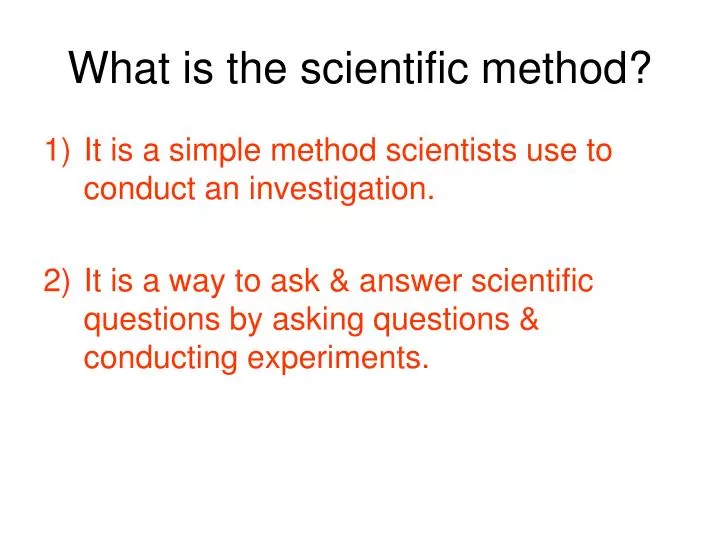
What is the scientific method? It is a simple method scientists use to conduct an investigation. It is a way to ask & answer scientific questions by asking questions & conducting experiments.
1. Question/Problem a) Ask a question about something observed. i) Why? ii) How? iii) What? b) Question to be solved. c) Must be about something measurable.
Examples of Problems (must be measurable) Does the amount of sunlight a plant gets affect how it grows? Does caffeine affect reaction time in middle school students? Which disinfectant works the best on household germs?
These Are Not Testable Questions Is Eli Manning the best quarterback of all time? Does water smell good? Will the school be open tomorrow? You cannot answer these questions with an experiment. Opinion questions are not testable.
2. Hypothesis a) Educated guess about how things work. b) Prediction c) Use If, then statements If ____ [I do this], then _____ [this will happen] d) Focus on one variable only. ** A variable is something that can change
Examples “If we fertilize the tomato plants, they will produce more tomatoes.” “If caffeine is increased in someone’s body, then their reaction time will be quicker”
3. Experiment a) Tests your hypothesis. Is your hypothesis right or wrong? b) Change only one variable at a time. c) Use a control or control group(A group that has nothing done to it. Standard used for comparison in an experiment.) d) Perform the test several times. e) Record your data.
4. Data Analysis a) Record your measurements in a chart. b) Graph • Graph the data to look for trends & relationships.
5. Conclusion a) Summary of your experiment. b) After your experiment, analyze your data to see if your hypothesis was accepted or rejected. c) If hypothesis is rejected, give possible reasons for the difference between your hypothesis and the experimental results.
MEMORY TRICK THE FIVE STEPS – Please help every dirty cat! Quest or Problem Please Hypothesis Help Experiment Every Data Dirty Conclusion Cat
MR. PARR https://www.youtube.com/watch?v=QuKRgjm0KJU