Download
1 / 3
30 likes | 149 Vues
This paper explores the geological history of the Eastern U.S. continental margin, particularly the Appalachian region, focusing on supercontinent cycles, deep crustal structures, and the persistence of Appalachian topography. It examines sharp gradients in Moho depths, potential magmatic underplating in the lower crust, and transition behaviors in shear wave splitting. The analysis includes significant seismic activities, such as the 2011 Mineral, VA earthquake, and investigates the youngest volcanic rocks in Eastern U.S., providing a comprehensive understanding of the region’s geodynamics through EarthScope initiatives.

E N D
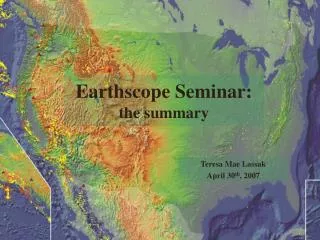
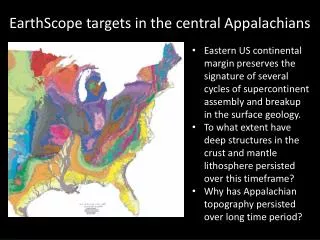
Eastern US continental margin preserves the signature of several cycles of supercontinent assembly and breakup in the surface geology. • To what extent have deep structures in the crust and mantle lithosphere persisted over this timeframe? • Why has Appalachian topography persisted over long time period? EarthScope targets in the central Appalachians
Central Appalachian swath: • Sharp gradients in Moho depths, perhaps corresponding with surface geologic structures (Benoit et al., in prep.). Possible magmatic underplating in lower crust? • Lateral transition in shear wave splitting behavior • Encompasses C. VA Seismic Zone (2011 Mineral, VA earthquake) • Encompasses youngest known volcanic rocks in the eastern US (Eocene basalts in and around Harrisonburg, VA) EarthScope targets in the central Appalachians
EarthScope targets in the central Appalachians Mid-Atlantic Geophysical Integrative Collaboration (MAGIC): FlexArray deployment + geomorphology/geodynamics component