Appendicular Skeleton
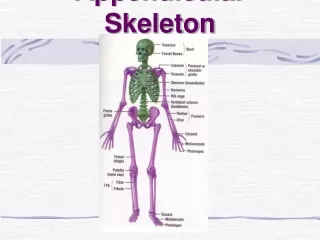
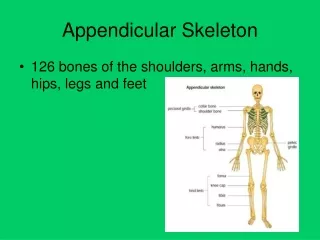
The appendicular skeleton comprises the bones of the arms and legs, including the shoulder and pelvic girdles. This overview focuses on the shoulder girdle, also known as the pectoral girdle, which consists of the clavicle and scapula. The clavicle connects the sternum to the scapula, while the scapula provides mobility and supports arm movement. Key features of the scapula include the glenoid cavity, coracoid process, acromion process, and various margins, each contributing to its functionality. For further exploration, visit the provided link for diagrams and quizzes.

Appendicular Skeleton
E N D
Presentation Transcript
Appendicular Skeleton Day 1 Shoulder Girdle
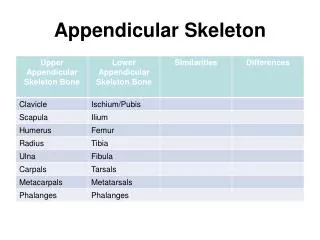
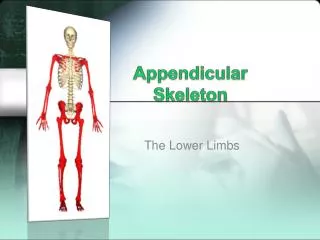
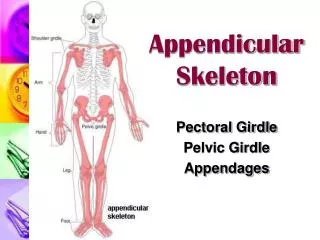
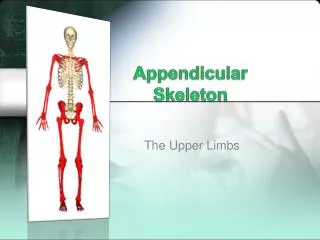
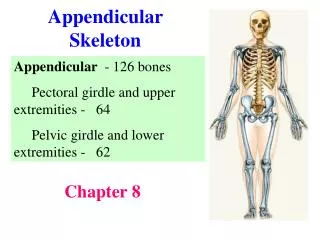
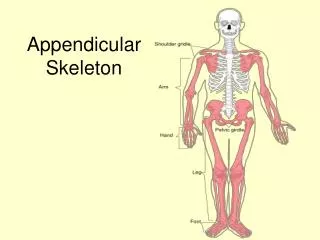
Appen….WHAT? • Appendicular skeleton: refers to the bones that make up our arms and legs. • These include: The shoulder girdle, the pelvic girdle, and the extremities of the arm and the leg.
Shoulder Girdle • The shoulder girdle (pectoral girdle) consists of • The clavicle (collar bone) • The scapula (the shoulder blade) • The clavicle: S shaped bone that articulates (connects) with the sternum medially and the acromion process of the scapula laterally. Simply, it connects the sternum to the scapula. • The scapula: flat with a ridge almost pergendicular to the flat plain. • It does not articulate with the axial skeleton but is held in place by muscles. Gives more mobility.
Parts of the scapula: • Glenoid Cavity: articulates with the head of the humerus. • Coracoid Process: Projects anteriorly to articulate with the clavicle. • Acromion Process: Projects posteriorly to articulate with the clavicle. • Spine: The ridge on the posterior surface • Vertebral margin: The medial edge that is closest to the ribs. • Scapular notch: A small dip in the bone on the superior aspect. • Superior margin: The upper most edge. • Axillary margin: Margin closest to the arm pit. • See http://www.personal.psu.edu/jas43/skel/scapula2.htm • For a diagram and self quiz