SlideServe
Menu
Préférences
© SlideServe · v2026

Upper Limb Anatomy and Disorders

ggentry avatar
32 diapositives · 449 Views · Jan 02, 2020

Explore the detailed anatomy of the pectoral girdle, upper limb bones, and common disorders such as carpal tunnel syndrome and rotator cuff injuries. Learn about surface markings and functions of each bone.
Upper Limb Anatomy and Disorders - slide 1
01 / 32Upper Limb Anatomy and Disorders
1 / 17

Télécharger la présentation

Upper Limb Anatomy and Disorders
Une image / un lien ci-dessous est fourni (tel quel) pour télécharger la présentation

Politique de téléchargement : le contenu du site vous est fourni TEL QUEL pour votre information et votre usage personnel ; il ne peut être vendu, concédé sous licence ni partagé sur d’autres sites sans l’accord de son auteur.Le contenu vous est fourni TEL QUEL, pour votre information et votre usage personnel uniquement. Téléchargez la présentation en cliquant sur ce lien. Lors du téléchargement, si vous ne parvenez pas à télécharger une présentation, l’éditeur a peut-être supprimé le fichier de son serveur.Pendant le téléchargement, si vous ne parvenez pas à obtenir une présentation, le fichier a peut-être été supprimé par l’éditeur.

F I N

Plus de contenu associé

Transcription de la présentation
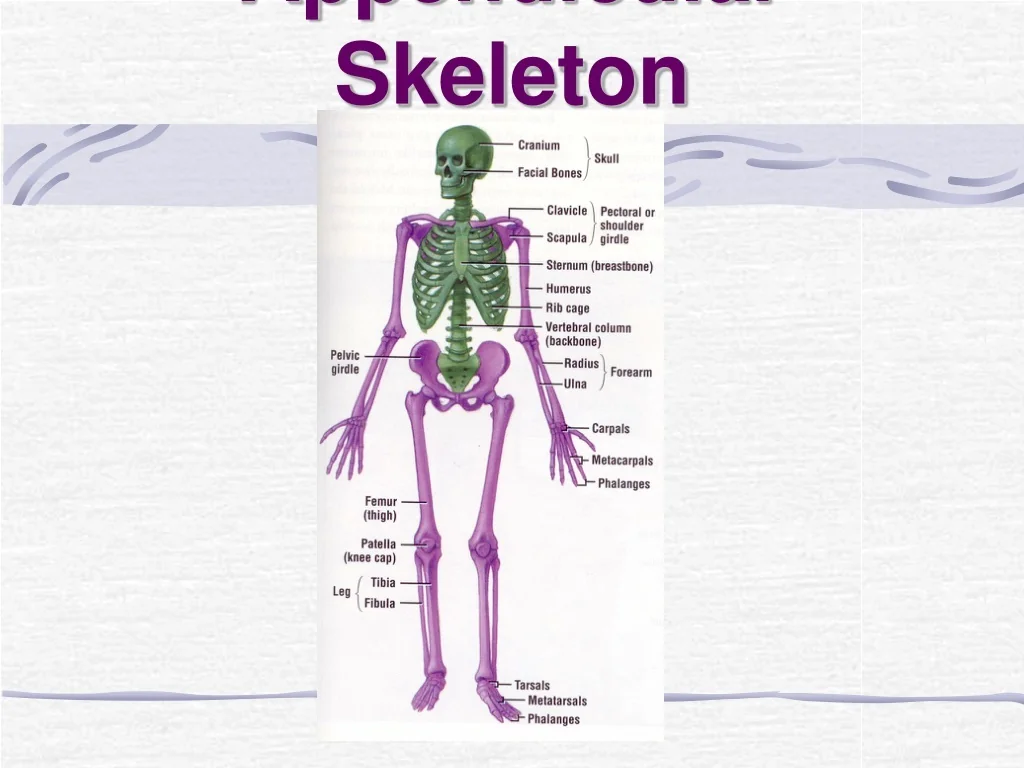
  1. Appendicular Skeleton

  2. Pectoral (Shoulder) Girdle

  3. Pectoral Girdle • Attach the bones of the upper limbs to the axial skeleton • Consist of two bones: clavicle and scapula • The joints are freely movable in many directions

  4. Clavicle • Also known as the collarbone • Long, slender S-shaped bone that is horizontally above the first rib • Transmits mechanical force from the upper limb to the trunk

  5. Scapula • Also known as the shoulder blade • Large, flat triangular bone situated in the posterior part of the thorax

  6. A sharp ridge, the spine, runs diagonally across the back portion of the scapula body • The lateral end of the spine is the acromion, where the scapula articulates with the clavicle

  7. The glenoid cavity is a depression inferior to the acromion. It articulates with the humerus head to form the shoulder joint. • The coracoid process is where muscles attach.

  8. Upper Limb

  9. Upper Limb • Consists of 30 bones (all paired up) • Humerus in the arm • Ulna and radius in the forearm • 8 carpals, 5 metacarpals, and 14 phalanges in the hand

  10. Humerus • Longest and largest bone of the upper limb • Articulates with the scapula at the shoulder and both the ulna and radius at the elbow

  11. Ulna • Located on the medial side of the forearm (pinky side) • Longer than the radius

  12. Radius • Located on the lateral side of the forearm (thumb side)

  13. Humerus Bone Surface Markings • Proximal end consists of a head that articulates with the scapula’s glenoid cavity and an anatomical neck where the epiphyseal plate used to be

  14. The body contains the deltoid tuberosity, a roughened V-shaped area where the deltoid muscle attaches

  15. At the distal end, the capitulum articulates with the head of the radius. • The radial fossa is a depression that receives the head of the radius when the forearm is bent.

  16. The trochlea is a spool-shaped surface that articulates with the ulna. • The coronoid fossa receives part of the ulna when the forearm is bent. • The olecranon fossa is a depression on the back of the bone that receives the ulna when the forearm is straightened.

  17. Ulna Bone Surface Markings • The olecranon forms the prominence of the elbow on the proximal end. • The coronoid process along with the olecranon receives the trochlea of the humerus in the trochlear notch.

  18. The radial notch is a depression for the head of the radius. • A styloid process is at the distal end.

  19. Radius Bone Surface Markings • Disc-shaped head at the proximal end articulates with the capitulum of the humerus and radial notch of the ulna • Radial tuberosity is a raised, roughened area that is where the biceps brachii muscle attaches to the bone

  20. The distal end of the radius articulates with three carpal bones • There’s a styloid process at the distal end (similar to the ulna)

  21. Carpus (Wrist) • 8 carpals • Held together by ligaments with four bones in each row • Named for their shapes • Short bones

  22. The carpals in the top row are the: • Scaphoid, Lunate, Triquetrum, and Pisiform • The carpals in the bottom row are the: • Trapezium, Trapezoid, Capitate, and Hamate

  23. Metacarpus (Palm) • 5 metacarpals • Each consists of a proximal base, an intermediate body, and a distal head • Numbered I-V starting with the thumb • Long bones

  24. Phalanges (Fingers) • 14 in each hand • Thumb has two (proximal and distal) • In each of the other four digits, there are three (proximal, middle, and distal)

  25. Disorders of the Upper Limb

  26. Carpal Tunnel Syndrome • Narrowing of the carpal tunnel causes compression of the median nerve • The nerve compression causes pain, numbness, tingling, and hand muscle weakness

  27. Rotator Cuff Injury • Tears or inflammation of ligaments and tendons of the shoulder near the humerus • Results in pain and loss of shoulder mobility

  28. Fractures

  29. Checkpoint Questions • Which bones make up a pectoral girdle? What is the function of the pectoral girdle? • With which part of the scapula does the humerus articulate? • What part of the ulna is called the “elbow”? • What part of which bones are commonly called the “knuckles”? • What bones form the upper limb, from proximal to distal?