Overview of Carboxylic Acids and Esters: Reactions, Properties, and Applications
This flow chart explores the chemistry of carboxylic acids and esters, detailing various organic reactions including esterification, hydrolysis, and condensation. It highlights the functional group structures, properties of esters, and their significance in nature, including their roles in creating pleasant smells found in fruits like bananas. The nomenclature rules for naming esters and acids are also summarized. Additionally, the chart emphasizes the importance of these compounds in analytical chemistry and their practical applications in products used for scent.

Overview of Carboxylic Acids and Esters: Reactions, Properties, and Applications
E N D
Presentation Transcript
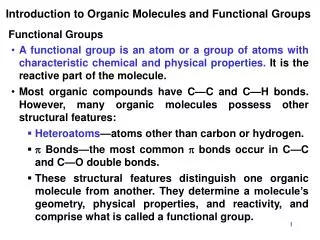
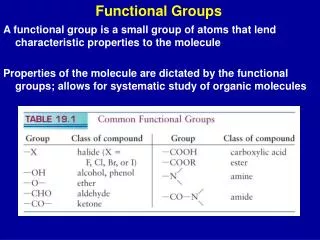
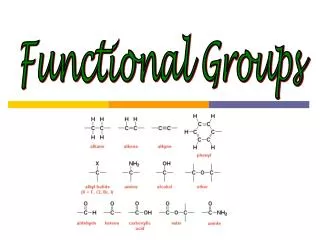
FUNCTIONAL GROUPS Carboxylic acids and Esters
Flow Chart of Organic Reactions esters amides alkenes addition + H2O +HX + H2 substitution dehydration alkanes alkyl halides + H2O alcohols + X2 (difficult) + NH3 (ammonia) ethers amines primary [O] secondary [O] aldehydes ketones [O] carboxylic acids amine or NH3 + + alcohol condensation condensation hydrolysis hydrolysis
ESTERS • often used as artificial smells to add • scent to products • sense of smell warned our ancestors (and warns us) of what is safe to eat • compounds called esters are responsible for many of the pleasant smells of fruits • ex. smell of bananas: 3-methylbutyl acetate
1) general formula 2) functional group - carbonyl from carboxylic acid and O from hydroxyl
3) properties • esters cannot form hydrogen-bonds with themselves but can with polar molecules • they are water soluble, but more hydrophobic than parent alcohol and parent carboxylic acid • more volatile than carboxylic acid of similar molecular weight • very useful in organic analytical chemistry ( gas chromatography, gas liquid chromatography, or mass spectrometry).
4) nomenclature: • name alcohol after COO, change “anol” to “yl” • name carboxylic acid, change “oic” to “oate” • ex.
5) How To Make Them: ESTERIFICATION - Condensation/Dehydration Reaction • between a carboxylic acid and an alcohol • can be split apart by hydrolysis
strawberries • ex. name the following: