Understanding the Laws of Reflection and Light Ray Behavior
This educational resource delves into the fundamental principles of light reflection using plane mirrors. It provides clear objectives, including tracing light rays and drawing conclusions about the law of reflection. The material covers the concepts of the angle of incidence and angle of reflection, articulating the laws governing these phenomena. Additionally, it emphasizes practical applications of plane mirrors in items such as periscopes and rear-view mirrors, and distinguishes between regular and diffuse reflection.

Understanding the Laws of Reflection and Light Ray Behavior
E N D
Presentation Transcript
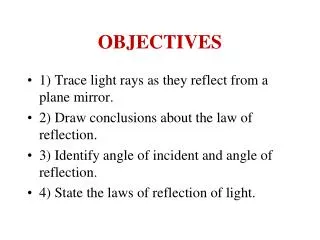
OBJECTIVES • 1) Trace light rays as they reflect from a plane mirror. • 2) Draw conclusions about the law of reflection. • 3) Identify angle of incident and angle of reflection. • 4) State the laws of reflection of light.
Reflection Draw around the mirror
Reflection normal
Reflection normal
Reflection normal
Reflection normal Angle of incidence
Reflection normal Angle of incidence
Reflection Angle of incidence = Angle of reflection Normal Reflected ray Incident ray Angle of reflection Angle of incidence Mirror
Can you copy please? Law of Reflection normal Angle of incidence Angle of reflection mirror angle of incidence = angle of reflection
The angle of incidence is equal to the angle of reflection. The image in a plane mirror is virtual and is the same size as the object. Plane mirrors are used in periscopes. They are used in rear view mirrors. The image is as far behind the mirror is as the object is in front. Image is laterally inverted THE LAW OF REFLECTION
Using mirrors • Two examples: 2) A car headlight 1) A periscope
Shiny smooth surfaces reflect regularly, other surfaces also reflect light but if the surface is rough the light is reflected in all directions. We call this diffuse reflection.