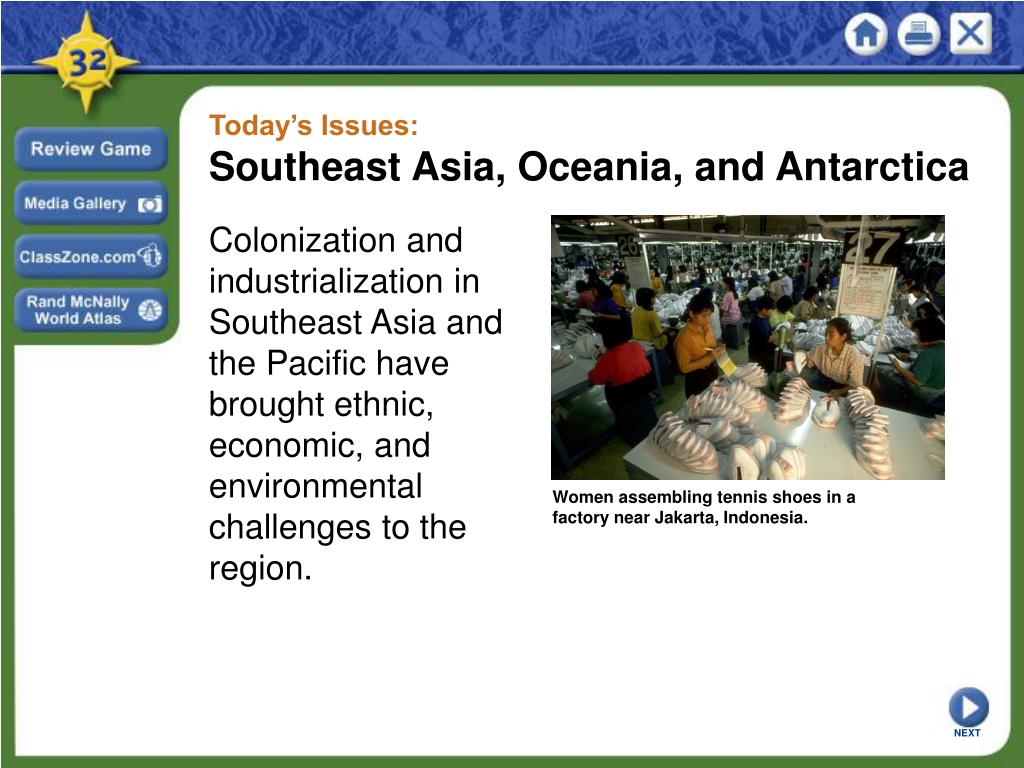
Today’s Issues: Southeast Asia, Oceania, and Antarctica Colonization and industrialization in Southeast Asia and the Pacific have brought ethnic, economic, and environmental challenges to the region. Women assembling tennis shoes in a factory near Jakarta, Indonesia. NEXT
Today’s Issues: Southeast Asia, Oceania, and Antarctica Aboriginal Land Claims SECTION 1 SECTION 2 Industrialization Sparks Change Global Environmental Change Case Study Unit Atlas: Physical Unit Atlas: Political NEXT
Section 1 Aboriginal Land Claims • The Aboriginal people of Australia lost their ancestral lands to European colonists. • Recently they have regained some of that land through court cases. NEXT
SECTION Aboriginal Land Claims 1 Aboriginal People Lose Land British Policy • Australian Aboriginal people didn’t farm, herd animals like Europeans - hunted and gathered; depended on nature • British colonists saw no Aboriginal ties to land - declared Australia Terra Nullius—“empty land” - British government decided to take land without making treaties Continued . . . NEXT
SECTION 1 continuedAboriginal People Lose Land Stolen Land • Europeans began settling in 1788 and chose most fertile regions • Aborigines fought invasion of their land, lost to superior weapons - some forced onto reserves—tracts of less productive land - others lived on edges of settlements, adopted European ways Image Continued . . . NEXT
SECTION 1 continuedAboriginal People Lose Land Stolen Children • From 1909 to 1969, 100,000 mixed-race children were taken - raised by white families to promote assimilation - assimilation—minority group gives up culture, adopts majority culture • Aborigines angrily call these children the Stolen Generation NEXT
SECTION 1 Land Claims Hard-Won Victories • Aboriginal people are not recognized as full citizens until 1967 - in 1967, 91% vote to pass special Aboriginal rights laws • Land Rights Act of 1976—Aborigines can claim Northern Territory land - Aboriginals gain ownership of reserves, other unoccupied lands Chart Continued . . . NEXT
SECTION 1 continuedLand Claims The Mabo Case • In 1992, High Court of Australia rules in important land-claims case • Eddie Mabo is a Torres Strait Islander - his family doesn’t own their traditional lands in the Murray Islands - but Mabos have worked the land for generations • In the Mabo Case, the court upholds Mabo’s claim - recognizes that Aborigines owned land before British arrived - case overturns the doctrine of Terra Nullius Map Continued . . . NEXT
SECTION 1 continuedLand Claims The Wik Case • Aboriginal Wik people claim land used by ranchers, mining companies • Government tracts of land are rented to ranchers in pastoral leases • Whites feel that the pastoral leases erase any native land claims • In 1996 Wik Case—Aborigines can claim pastoral-lease land • Afraid of paying Aborigines for land use, government amends Wik - wipes out many land claims; Aboriginal groups threaten lawsuits NEXT
Section 2 Industrialization Sparks Change • The growth of industry in Southeast Asia has produced positive results such as new jobs and higher wages. • The growth of industry also produced negative results such as overcrowded cities and pollution. NEXT
SECTION Industrialization Sparks Change 2 Moving to Find Jobs From Farms to Cities • In struggle to escape poverty, any job is better than none - even if it means long hours, low pay, abusive managers • Growth of cities is linked to industrialization—growth of industry • People move to cities because of push-pull factors - push factors—forces that push people out of homelands - pull factors—forces that pull people to a new place Continued . . . NEXT
SECTION 2 continuedMoving to Find Jobs Push Factors • Lost resources—rural soil erosion, deforestation, water overuse • Scarcity of land—in Philippines 3% of landowners hold 25% of land - 60% of rural families don’t have enough land to earn a living farming • Population growth—as populations grow, land shortages increase - farmers divide land among heirs—plots become too small Continued . . . NEXT
SECTION 2 continuedMoving to Find Jobs Pull Factors • Industry—opportunity for factory jobs - many move to city temporarily, send money home to rural area - in 1993, Filipino workers sent home $2.2 billion - Thai workers sent home $983 million • Other benefits—cities offer education, government services - desire for education is usually related to desire for jobs Continued . . . NEXT
SECTION 2 continuedMoving to Find Jobs Impact on Cities • Southeast Asian cities have trouble dealing with numerous immigrants • Housing availability can’t keep pace—many immigrants live in slums • Traffic increases due to workers driving, trucks hauling goods - creates more pollution, particulates - in Bangkok, Thailand, 5,000 a year die from breathing polluted air • Most cities don’t have adequate sewage treatment Image NEXT
SECTION 2 Other Results of Industrialization Economic Effects • Several countries have had rapid industrial growth since 1960s - results in increase in trade and exports • Growing industry means higher incomes for some citizens - middle class expands in some countries • Income gap between rich and poor remains high - few people have wealth; many live in poverty - leads to rising crime rates, social unrest Continued . . . NEXT
SECTION 2 continuedOther Results of Industrialization Environmental Effects • Industry damages environment; factories pollute air, water, soil - burn fossil fuels, dump toxic materials • Hard to control pollution due to nature of Southeast Asian industry - cities have thousands of small factories - 30,000 in Jakarta, Indonesia • Industry uses up resources like water and trees Image NEXT
Case Study Global Environmental Change How Have People Changed the Atmosphere? BACKGROUND • Human activities, like burning fossil fuels, harm the environment • Also, use of chemicals—chlorofluorocarbons (CFCs) in aerosol cans • Scientists fear these activities change the worldwide environment NEXT
Case Study Damage to the Environment Global Warming • Burning fossil fuels releases carbon dioxide (CO2) into atmosphere - CO2 is greenhouse gas—traps sun’s heat • Some scientists fear atmosphere now has too many greenhouse gases - CO2 emissions have increased 50% since 1970s - atmosphere might trap too much heat, raising temperatures • Many disagree with global warming theory - say temperature increases are natural Continued . . . NEXT
Case Study continuedDamage to the Environment Ozone Hole • Ozone layer is high in the atmosphere - absorbs most of sun’s damaging ultraviolet rays • In 1970s, scientists found thinning of ozone layer over Antarctica - called it a hole in the ozone • Chemicals like chlorine in CFCs destroy ozone - many governments restrict use of such chemicals - others delay passing laws because they are costly for industry NEXT
Case Study Looking Toward the Future Long-Term Effects • Global warming fear: small temperature increase could melt ice caps - rising seas may swamp coastal cities, Oceania’s low islands • Warming might change evaporation, precipitation patterns - create violent storms like typhoons and increase droughts - shift climate zones and agricultural regions, upset economies • Ozone hole lets in more ultraviolet rays - cause skin cancer, eye damage, crop damage Interactive Continued . . . NEXT
Case Study continuedLooking Toward the Future Taking Action • In 1992, UN holds Earth Summit; 178 nations attend conference - discuss economic development while protecting environment • In 1997, UN convention in Kyoto, Japan, discusses climate change - writes Kyoto Protocol and 165 nations sign treaty - guidelines to reduce greenhouse gas emissions • U.S. signs treaty, but Senate doesn’t ratify it NEXT
This is the end of the chapter presentation of lecture notes. Click the HOME or EXIT button.
Print Slide Show • 1. On the File menu, select Print • 2. In the pop-up menu, select Microsoft PowerPointIf the dialog box does not include this pop-up, continue to step 4 • 3. In the Print what box, choose the presentation format you want to print: slides, notes, handouts, or outline • 4. Click the Print button to print the PowerPoint presentation • Print Text Version • 1. Click the Print Text button below; a text file will open in Adobe Acrobat • 2. On the File menu, select Print • 3. Click the Print button to print the entire document, or select the pages you want to print Print Text Print Text CONTINUE