Enhancing Wildlife Safety: Effective Underpasses and Their Specifications
160 likes | 284 Vues
This guide explores the effectiveness of wildlife underpasses, achieving an average success rate of 87% when combined with large-mammal fencing. We discuss various types of crossing structures, dimensions, and the impact of surrounding terrain on implementation. Recommendations include raising roadways to minimize excavation, ensuring visibility for animals, and employing sound-attenuating measures. Additionally, it covers cost considerations and maintenance strategies to ensure long-term effectiveness in wildlife preservation.


Enhancing Wildlife Safety: Effective Underpasses and Their Specifications
E N D
Presentation Transcript
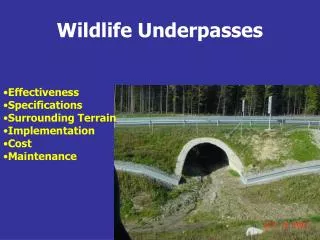
Wildlife Underpasses • Effectiveness • Specifications • Surrounding Terrain • Implementation • Cost • Maintenance
Effectiveness 87 percent (average) when used in combination with large-mammal fencing
Specifications . Dimensions of the three different types of crossing structures. 4
Surrounding Terrain Roadway is relatively higher than the surrounding terrain • The roadbed does not have to be : • raised • the approaches lowered • reduces the overall excavation
It is advisable: To allow animals to see to the other side Avoid flooding of underpasses and the associated soil erosion
Wildlife fencingalongside the road corridor typically ties into the wing walls of the underpass or the structure itself ( above for smaller culverts) Noise and light disturbancefrom the road need to be minimized (e.g., employing sound-attenuating walls above the entrances).