Download
1 / 5
50 likes | 170 Vues
Learn how to conduct t-tests by hand in four simple steps. Start by setting up your null and alternative hypotheses while determining if your test is directional or non-directional. Next, calculate the t-critical value from the appropriate statistical table. Depending on your data type, compute the t-obtained for one-sample, independent, or paired samples using the provided formulas. Finally, compare your t-obtained value to the t-critical value. If t-obtained exceeds t-critical, you achieve statistical significance.

E N D
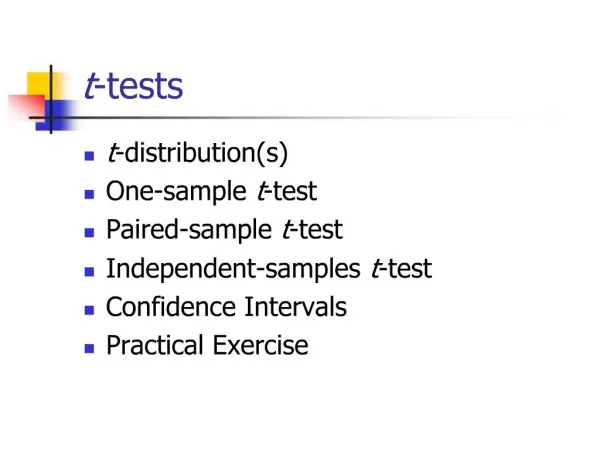
Four steps • Set up null and alternative hypothesis • Directional? Non-directional? • Determine t-critical from table • One-sample? Independent sample? Dependent (or paired sample)? • Compute t-obtained • Compare t-obtained to t-critical. If t-obtained is larger then you have significance
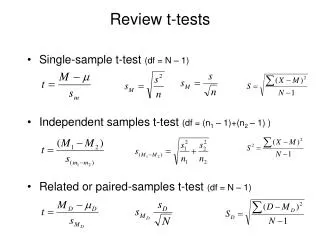
Formula for one sample • t obtained = Sample mean – Population mean / standard error of mean
Independent samples • t obtained = M1 – M2 / standard error of difference between the means
Dependent or Paired Samples • Be sure to work with the Differences between your paired scores – NOT the original scores • t obtained = mean of differences / standard error of mean of differences