Understanding Cell Structure and Function: Prokaryotic vs. Eukaryotic Cells
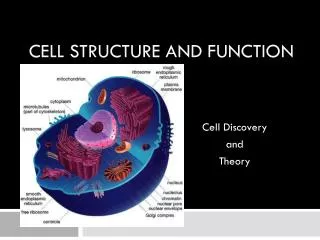
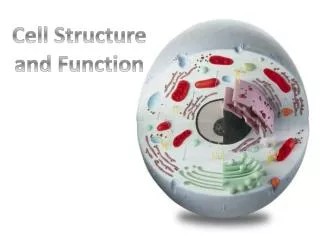
Explore the fascinating world of cells, the basic units of life. All living organisms are composed of one or more cells, classified into either prokaryotic or eukaryotic types. This guide discusses key differences, including the presence of a nucleus, organelles, and cell structures like the cytoplasm and mitochondria. We delve into important organelles such as ribosomes, endoplasmic reticulum, Golgi bodies, and lysosomes, explaining their functions in protein synthesis, lipid production, digestion, and energy generation.

Understanding Cell Structure and Function: Prokaryotic vs. Eukaryotic Cells
E N D
Presentation Transcript
Cell Structure and Function
All living thingsare made up of one or more CELLS! • Cells are either prokaryotic or eukaryotic • What are the differences?
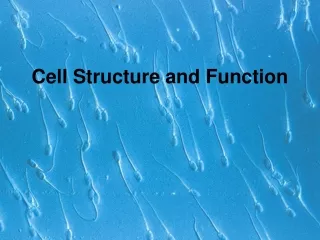
Cell Types Can you guess what each of these cells are?
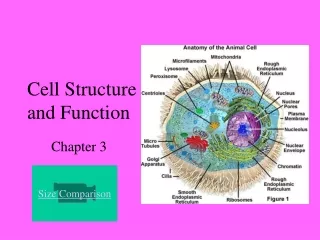
1. The Nucleus *Contains genetic material - Chromosomes i) Nuclear Envelope – 2 membranes with pores ii) Chromatin – thread like Becomes chromosomes (condenced) during cell division Meaningful parts=genes Made of - DNA & proteins iii) NucleOlus – dark center Makes rRNA (ribosomal RNA)
2.Cytoplasm • All other organelles found here • Defined by cell membrane & envelope • Cytoskeleton – maintains cell’s shape
Organelles in the Cytoplasm Ribosomes • smallest organelle • Made of rRNA (made ______?) &proteins • Site of protein synthesis
2 types of Ribosomes Free Floating • Make proteins for cell use Embedded in ER • Make proteins for export out of cell
ER – interconnected membrane, tubular canals,begin at nuclear envelope RER • Studded with ribosomes • Synthesize proteins for export (use outside of the cell) • Ex - insulin SER • NO ribos • Synthesize lipids • (ex. Male testes – make testosterone – a lipid steroid – so lots of SER) • Help liver in detox. process
Golgi Bodies • Flattened sacs (NOT CONNECTED!!!!) • Closer to cell membrane • Sort & separates proteins & lipids • Modifies some molecules • Packages materials for export/or to stay • PACKAGING
Lysosomes double membrane -formed by G.B. • Contain HYDROLYTIC enzymes -- carry out HYDROLYSIS • Digest food particles, destroy old cells • AUTODIGESTION – tadpole tail
Mitochondria (kidney bean) • Double membrane • Has own DNA • Similar to chloroplast • Site of CELLULAR RESPIRATION • OXYGEN + GLUCOSE ---- CARBON DIOXIDE + ATP + WATER
Chloroplasts • ONLY in plants • Contains chlorophyll • Site of PHOTOSYNTHESIS