Exciting Developments in Molecular Biology
170 likes | 289 Vues
Discover the latest advancements in molecular biology through the lens of amateur scientist Dr. Ray Sepeta. This guide covers fundamental concepts like DNA sequences, the central dogma of molecular biology, and the genetic code. Learn about the significance of coding and non-coding regions in DNA, the role of RNA in gene expression, and the importance of proteomics. With insights on prokaryotic and eukaryotic cells, this overview sheds light on recent discoveries about introns and RNA molecules that challenge traditional views on genetic material and protein synthesis.


Exciting Developments in Molecular Biology
E N D
Presentation Transcript
Exciting Developments inMolecular Biology As seen by an amateur
Dr. Ray Sepeta 631-7421 sepeta@nd.edu
DNAsequences of nucleotides • A – Adenine • C – Cytosine • G – Guanine • T – Thymine • N – any nucleotide base • R – A or G • Y – C or T • - none (gap)
RNA • A – Adenine • C – Cytosine • G – Guanine • U - Uracil
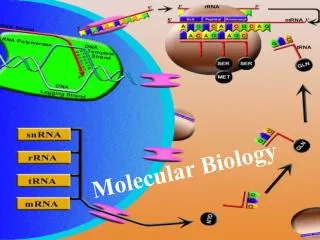
Central DogmaDNA RNA Protein transcription translation
G – Glycine – Gly A - Alanine – Ala L – Leucine – Leu M – Methionine – Met F - Phenylalanine-Phe W – Tryptophan – Trp K – Lysine – Lys S – Serine – Ser N – Asparagine – Asn D – Aspartic acid – Asp B – Aspartate - Asx P – Proline – pro V – Valine – Val I – Isoleucine – Ile C – Cysteine – Cys Y – Tyrosine – Tyr H – Histidine – His R – Arginine – Arg T – Threonine – Thr Q – Glutamine – Gln E – Glutamic acid – Glu Z – Glutamate - Glx Proteinsstrings of amino acids
Genetic Code Middle Base 5’ Base U C A G 3’ Base U phe ser tyr cys U phe ser tyr cys C leu ser quit quit A leu ser quit trp G C leu pro his arg U leu pro his arg C leu pro gln arg A leu pro gln arg G A ile thr asn ser U ile thr asn ser C ile thr lys arg A met thr lys arg G G val ala asp gly U val ala asp gly C val ala glu gly A val ala glu gly G
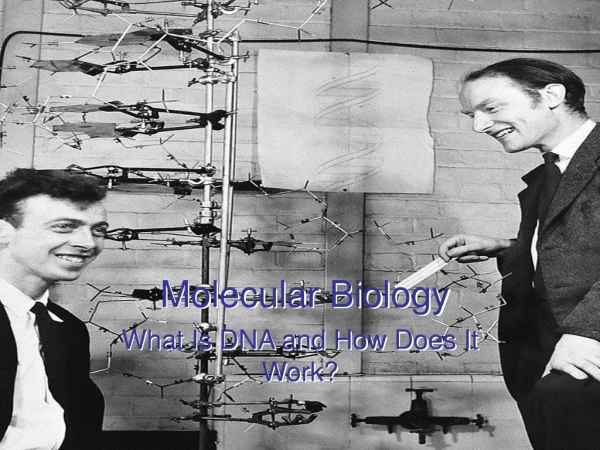
gene chromosome DNA base pairs RNA Watson and Crick Avery Hershey and Chase proteins amino acids genetic code codon central dogma sequence of DNA that codes for a protein contiguous stretch of DNA, contains many genes double helix of base pairs A, C, T, G A – T, G - C ribosomal, messenger, transfer (U for T) discovered structure DNA discovered transforming principle of DNA blender experiment sequence of amino acids, selected by codons and tRNA for proteins codon => amino acid three base pairs-together see slide
virus bacteria prokaryote eukaryote nucleus cytoplasm exons introns number of genes c.elegans corn insects humans DNA (or RNA) in protein coat cell-metabolizes food to function cell without nucleus cell with a nucleus where mRNA is transcribed from DNA outside nucleus, proteins formed stretches of DNA converted to genes DNA excised, “junk” DNA 19,000 40,000 13,500 27,000
In prokaryotes there is no nucleus so transcription and translation occur almost simultaneously. So there is no time to splice out RNA segments
Among eukaryotes as their complexity increases generally so too does the proportion of their junk DNA that does not code for protein
Arguably the most important advance in biology in decades has been the discovery that RNA molecules can regulate the expression of genes. - Sharp
The failure to recognize the importance of introns may well go down as one of the biggest mistakes in the history of molecular biology
Less than 1.5 % of the human genome encodes for protein.
Either the human genome (and that of other complex organisms) is replete with useless transcription, or these nonprotein-coding RNAs fulfill some unexpected function
Generating complexity is easy, controlling it is not.
Sources • Censors of the Genome, Sci. Am, Aug 03 • Unseen Genome, Sci. Am, Nov 03 • RNAi Revolution, Nature, Jul 04 • Hidden Genetic Program, Sci. Am, Oct 04 • Alternate Genome, Sci. Am, Apr 05