Understanding Refrigerants, Compressors, and Heat Exchangers in HVAC Systems
This comprehensive overview covers essential concepts in refrigeration and HVAC systems, focusing on refrigerants, compressors, and heat exchangers. It delves into operational principles, including the functionality of reciprocating compressors, expansion valves, and the intricacies of refrigerant behavior. The roles of varying refrigerants like R-12, R-22, R-717, and R-744 are analyzed, along with their environmental impacts and performance considerations. Key insights on heat exchanger effectiveness help improve system efficiency. This guide serves as a resource for optimizing refrigeration system performance.

Understanding Refrigerants, Compressors, and Heat Exchangers in HVAC Systems
E N D
Presentation Transcript
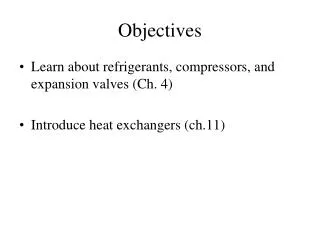
Objectives • Learn about refrigerants, compressors, and expansion valves (Ch. 4) • Introduce heat exchangers (ch.11)
Reciprocating • Piston compressing volume • PVn = constant = C • For all stages, if we assume no heat transfer • Can measure n, but dependent on many factors • Often use isentropic n in absence of better values • R-12 n =1.07 • R-22 n = 1.12 • R-717 n = 1.29
Summary • Many compressors available • ASHRAE Handbook is good source of more detailed information • Very large industry
Expansion Valves • Throttles the refrigerant from condenser temperature to evaporator temperature • Connected to evaporator superheat • Increased compressor power consumption • Decreased pumping capacity • Increased discharge temperature • Can do it with a fixed orifice (pressure reducing device), but does not guarantee evaporator pressure
Thermostatic Expansion Valve (TXV) • Variable refrigerant flow to maintain desired superheat
AEV • Maintains constant evaporator pressure by increasing flow as load decreases
Summary • Expansion valves make a big difference in refrigeration system performance • Trade-offs • Cost, refrigerant amount • Complexity/moving parts
In Addition…. • Toxicity • Flammability • Ozone-depletion • Greenhouse potential • Cost • Leak detection • Oil solubility • Water solubility
Refrigerants • What does R-12 mean? • ASHRAE classifications • From right to left ← • # fluorine atoms • # hydrogen atoms +1 • # C atoms – 1 (omit if zero) • # C=C double bonds (omit if zero) • B at end means bromine instead of chlorine • a or b at end means different isomer
Refrigerant Conventions • Mixtures show mass fractions • Zeotropic mixtures • Change composition/saturation temperature as they change phase at a constant pressure • Azeotropic mixtures • Behaves as a monolithic substance • Composition stays same as phase changes
Inorganic Refrigerants • Ammonia (R717) • Boiling point • Critical temp = 271 °F • Freezing temp = -108 °F • Latent heat of vaporization • Small compressors • Excellent heat transfer capabilities • Not particularly flammable • But…
Carbon Dioxide (R744) • Cheap, non-toxic, non-flammable • Critical temp? • Huge operating pressures
Water (R718) • Two main disadvantages? • ASHRAE Handbook of Fundamentals Ch. 20
Water in refrigerant • Water + Halocarbon Refrigerant = (strong) acids or bases • Corrosion • Solubility • Free water freezes on expansion valves • Use a dryer (desiccant) • Keep the system dry during installation/maintenance
Oil • Miscible refrigerants • High enough velocity to limit deposition • Especially in evaporator • Immiscible refrigerants • Use a separator to keep oil contained in compressor • Intermediate
The Moral of the Story • No ideal refrigerants • Always compromising on one or more criteria
Heat exchangers Air-liquid Tube heat exchanger Air-air Plate heat exchanger
Some HX (Heat Exchanger) truths • All of the energy that leaves/enters the refrigerant enters/leaves the heat transfer medium • If a HX surface is not below the dew point of the air, you will not get any dehumidification • Water takes time to drain off of the coil • Heat exchanger effectivness varies greatly
Heat Exchanger Effectiveness (ε) C=mcp Mass flow rate Specific capacity of fluid THin TCout THout TCin Location B Location A
Example: What is the saving with the residential heat recovery system? Outdoor Air 32ºF 72ºF 72ºF Combustion products 52ºF Furnace Exhaust Fresh Air Gas For ε=0.5 and if mass flow rate for outdoor and exhausted air are the same 50% of heating energy for ventilation is recovered! For ε=1 → free ventilation! (or maybe not)
Air-Liquid Heat Exchangers Coil Extended Surfaces Compact Heat Exchangers • Fins added to refrigerant tubes • Important parameters for heat exchange?
What about compact heat exchangers? • Geometry is very complex • Assume flat circular-plate fin
Overall Heat Transfer Q = U0A0Δtm Overall Heat Transfer Coefficient Mean temperature difference
Heat Exchangers • Parallel flow • Counterflow • Crossflow Ref: Incropera & Dewitt (2002)
Heat Exchanger Analysis - Δtm Counterflow For parallel flow is the same or