Download
1 / 13
150 likes | 278 Vues
This update provides a comprehensive overview of low-leak valve technology and recent regulatory developments. It covers new Consent Decrees (CDs) and Enhanced Leak Detection and Repair (ELP) requirements enforced by the EPA for 2014-2016. The discussion includes total valve ownership costs while comparing low-leak (LLT) valves to traditional valves, emphasizing their cost-effectiveness. Key aspects include valve tightening, monitoring practices, and the connection to EPA's Air Toxics National Enforcement Initiative. This information is essential for facilities considering upgrades to comply with stringent emission regulations.

E N D
Outline • Refresher from Last Year • New CDs • New ELP Requirements • Total Valve Ownership Cost • Conclusions
Why an update? • EPA renewed the Air Toxics National Enforcement Initiative for another 3 years from 2014-2016 • Ongoing since 2005, continues to target LDAR • 2 new CDs lodged since last year’s conference • 8 CDs that now include Enhanced LDAR Program (ELP) requirements • New ELP requirements • Valve tightening, existing valve replacement/repack, optional monitoring • Desire to understand “Total Valve Ownership” cost • Valve lifetime cost for low-leak technology (LLT) valves vs. non-LLT
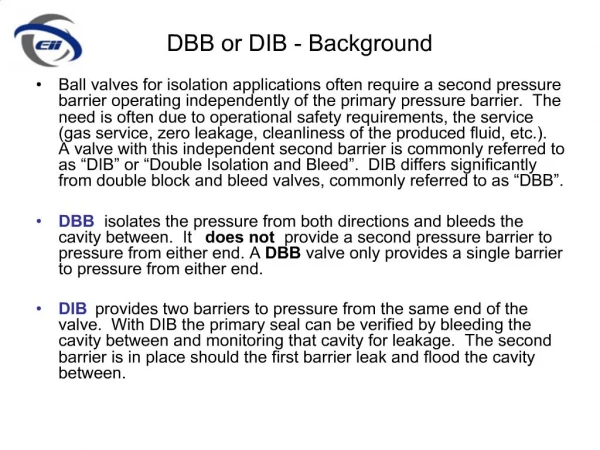
Refresher: Low-Leak Valve Technology • Defined in CDs under: • Certified Low-Leaking Valves, Low-Emissions Valve, Low-E Valve • Certified Low-Leaking Valve Packing Technology, Low-Emissions Packing, Low-E Packing • Manufacturer guarantee that valve/packing will not leak above 100 ppm for 5 years • Guarantee or certification that valve/packing has been tested and found to not be leaking > 100 ppm
Refresher: Typical ELP LLT Requirements Valve internal leak definition is 250 ppm • Every new valve shall be a certified Low-E Valve/Packing • Replace/repack valves leaking > 250 ppm with Low-E technology identified during any regular monitoring event • Replace/repack valves with Low-E technology leaking between 100 and 250 ppm • Low-E valve/packing leaking > 250 ppm • Low-E status not invalidated, 5/15 day repair attempts • Replace/repack if leak > 500 ppm • Commercial unavailability exclusion for Low-E technology • Connector improvement and replacement program
New ELP Requirements • Valve Tightening Work Practices • After installation, ensure the valve packing gland nuts or equivalent are tightened to: • The manufacturer’s recommended gland nut/packing torque OR • Any appropriate tightness that will minimize the potential for fugitive emission leaks of any magnitude • Replacement or Repack of All Existing Valves during next process unit turnaround • Includes those valves not leaking > 250 ppm • Replacement schedule is phased according to unit • Voluntary pre-CD installation of 1,200 Low-E valves
New ELP RequirementsOptional • Proactive Monitoring and Repair Practices relating to All Valves • May undertake either Method 21 or an IR Camera survey following a shutdown that involves thermal cycling • In addition to regular Method 21 monitoring • Must also monitor via Method 21 following detection of leak using IR Camera • Any leak rate detected > 250 ppm does not require replacement/repack with Low-E
Comparison of Low-E Valve ELP Requirements A-Ineos Lanxness; B-Vertellus; C-Formosa; D-Dow; E-Sabic; F-Ineos Lima; G-DuPont; H-FHR
Refresher: Cost of Low-E Valve Technology • Last Year • Performed an analysis to determine cost of Low-E valves vs. “regular” valves • The analysis suggested that Low-E was cost-effective with little to no difference in Low-E vs. “regular” valve cost • Slight premium for larger valves (hundreds, not thousands) due to Low-E packing • Conclusion: Non-material increase of costs for equipment associated with implementing a low-leak technology program on one-to-one valve replacement basis • Would it make sense for non-CD facilities to use Low-E for expansion projects?
Use Low-E for expansion projects for a non-CD facility? • Population of 1,000 valves • Regular valve population leak rate of <2%, quarterly M21 • Low-E valve population leak rate < 0.1%, annual M21 • Assume 2-hour installation, 5-year life at 10% interest • Assume technician monitors 250/day in 40 hrs at $35/hr • Repair per valve takes 4 hrs at $40/hr
Results • Direct – valve, packing, and installation cost • Indirect – capital recovery (5-year equipment life at 10% interest) • Monitoring • Regular; 5 years of quarterly M21 • Low-E; 1st year (2 quarters, then semiannual M21), annual thereafter • Leak Repair • Regular; 2% leak rate per monitoring event • Low-E; 0.1% leak rate per monitoring event
Conclusions • New ELP requirements indicate that EPA is continually looking at ways to increase LDAR enforcement • For a non-CD facility considering an expansion, the total ownership costs associated with Low-E valves for a non-CD facility expansion, when compared to “regular” valves, appear to be comparable over a 5-year period when factoring in repair and monitoring costs Final Thought • Will proactively installing Low-E valves improve my facility’s standing with the EPA and mitigate any potential enforcement action?
Contact Information John Butow, P.E. 75 Valley Stream Parkway, Suite 200 Malvern, PA 19355 john.butow@erm.com 484.913.0342 The world’s leading sustainability consultancy