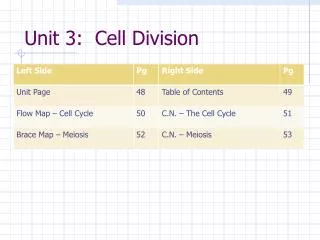
Unit 3: Cell Division
360 likes | 519 Vues
Unit 3: Cell Division. Meiosis. Unit 3: Cell Division Chapter 11-4. Learning Goals. 1. Describe the overall process of meiosis. 2. Define homologous chromosomes and explain diploid and haploid. 3. Explain crossing over, its importance, and during which step it occurs.


Unit 3: Cell Division
E N D
Presentation Transcript
Meiosis Unit 3: Cell Division Chapter 11-4
Learning Goals • 1. Describe the overall process of meiosis. • 2. Define homologous chromosomes and explain diploid and haploid. • 3. Explain crossing over, its importance, and during which step it occurs. • 4. Describe the two types of gamete formation and how fertilization occurs.
Meiosis • A process of cell division that creates gamete cells, or non-identical cells with half the number of chromosomes • The gametes from a male and a female combine in sexual reproduction to make a new individual
Homologous Chromosomes • Each cell has 2 sets of chromosomes • Homologous Chromosomes = a pair of chromosomes that have the same genes at the same locations • 1 came from mom • 1 came from dad
Homologous chromosomes From mom From dad
Chromosome Number • Diploid (2n): cells that have 2 sets of homologous chromosomes (2n) • Human body cells are diploid (46 chromosomes or 23 pairs) • Haploid (n): cells that have 1 set of chromosomes (n) • sex cells (gametes) are haploid • human haploid cells (egg & sperm) have 23 chromosomes total
Diploid meiosis meiosis Haploid gamete Haploid gamete • 1) A bug has a haploid number n=5. What is the diploid number (2n)? • 2) A crocodile has a diploid number 2n=50. What is the haploid number (n)? 2n n n
Down Syndrome Female Trisomy
Meiosis Overview • A type of cell division specific to sexual reproduction (two parent cells) • Cells (diploid) divide twice resulting in 4 daughter cells (haploid) • Each cell has half the number of chromosomes as the original cell • Each new cell is genetically different
Interphase • DNA is copied before the start of Meiosis I. • This makes 2 identical sister chromatids • They have the same genes at the same locations.
Homologous chromosomes vs. sister chromatids From mom From dad
Meiosis 1 • Four steps: • Prophase 1 • Metaphase 1 • Anaphase 1 • Telophase 1
Prophase 1 • The homologous pairs of chromosomes come together and line up side by side. (tetrad = 4)
Crossing-over • Homologous chromosomes can Cross-over and exchange a portion of the chromosome (DNA) at random
Crossing-over is very important in meiosis because it createsgenetic variation (new combinations of genes), which makes us all different. • This is why you do not look exactly like your siblings.
Red hair Freckles • Crossing over happens randomly. • However, some genes are linked, or close together on the chromosome, meaning they are more likely to be inherited together. Chromosome 16
After crossing-over, the homologous chromosomes separate & the cells divide
Meiosis II • Four steps: • Prophase 2 • Metaphase 2 • Anaphase 2 • Telophase 2
Sister chromatids separate & the cells divide. • Result is 4 genetically different haploid daughter cells
Principal of Independent Assortment • Genes for different traits can segregate (separate) independently during the formation of gametes. • Independent assortment and crossing-over account for the many genetic variations observed in plants, animals, and other organisms.
Assume there was only one cross-over in a man’s sperm and one cross-over in a woman’s egg, they have the possibility of producing 4,951,760,200,000,000,000,000,000,000 genetically different children
23 23 23 23 Gamete Formation • Gametes = Sex Cells (eggs & sperm) • Spermatogenesis: • In males meiosis occurs in the testes • produces 4 sperm
Oogenisis: • In females meiosis occurs in the ovaries • produces only 1 egg and 3 polar bodies Egg 23 Polar Bodies
23 23 Zygote 46 First cell of a new organism • Fertilization: the fusion of haploid sex cells
Only one sperm and one egg come together • The first sperm to reach the egg will be the one to fertilize it.
Comparing Mitosis & Meiosis • Mitosis results in the production of 2 genetically identical diploid cells. • Meiosis produces 4 genetically different haploid cells.
Learning Goals • 1. Describe the overall process of meiosis. • 2. Define homologous chromosomes and explain diploid and haploid. • 3. Explain crossing over, its importance, and during which step it occurs. • 4. Describe the two types of gamete formation and how fertilization occurs.