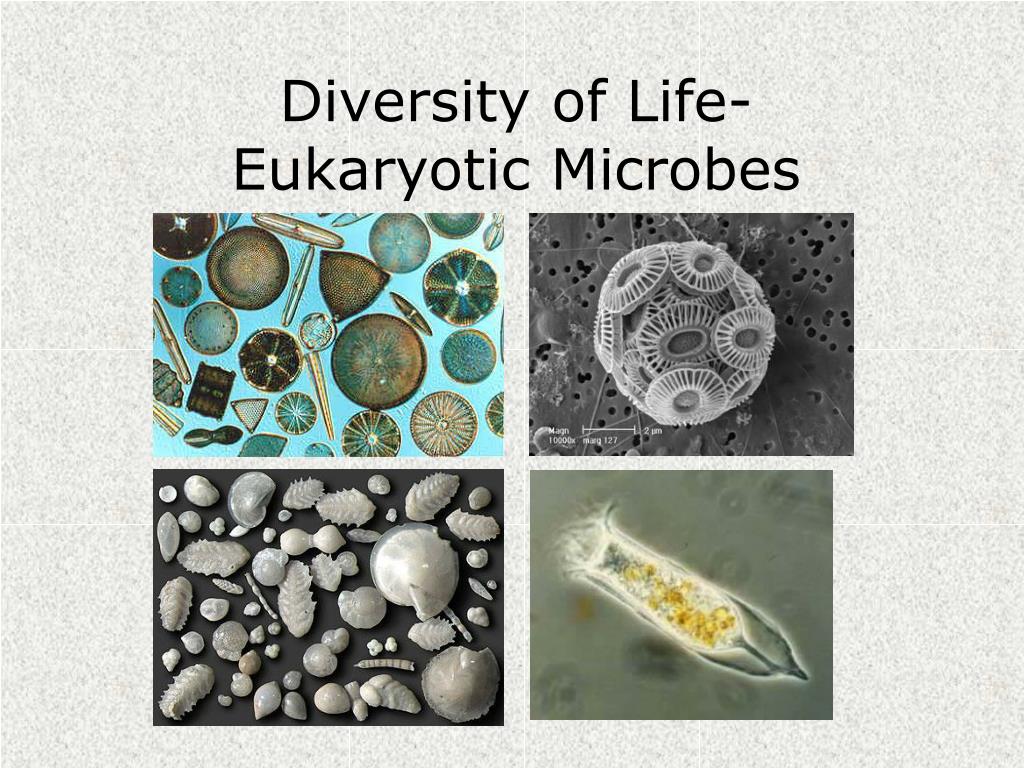
Diversity of Life- Eukaryotic Microbes
Diversity of Life Kingdom
Kingdom Fungi • Uni- or multi-cellular • Marine are mostly microscopic • Like bacteria, are important decomposers • Cell walls made of chitin http://www.uni-bonn.de/www/Pharmazeutische_Biologie/Forschung/Koenig/Marine_Microorganisms/bilder/Bild1.jpg
Kingdom Protista • Three groups: • Animal-like, microscopic, unicellular (protozoans) • Plant-like, microscopic, unicellular (microalgae, phytoplankton) • Plant-like, macro, mostly multicellular (macroalgae, seaweeds)
Protozoans • Animal-like protists • Heterotrophs – must eat • Single cell (unicellular) • 50,000+ species, difficult to classify • Some parasitic
Foraminifera • Ameboid organism inside calcareous (CaCO3) shell • Pseudopodia extend through pores in shell • Planktonic or benthic http://www.bio.umass.edu/oeb/files/foraminifera.jpg http://discovermagazine.com/2009/mar/05-what-is-this-a-windshields-worst-nightmare/foraminifera.jpg
Foraminifera • Shells become large part of sediment and beach sand http://farm3.staticflickr.com/2191/2385069810_c99c8fa0f0_o.jpg http://www.foraminifera.eu/ http://en.wikipedia.org/wiki/File:2085f_Japon_Hatoma.jpg http://virtual.yosemite.cc.ca.us/randerson/Marine%20Invertebrates/Foraminifera.jpg http://www.microscopy-uk.org.uk/mag/imgapr00/dwslide5.jpg
Foraminifera • Shells become large part of sediment and beach sand http://i1.trekearth.com/photos/30568/bermudabeach1.jpg http://www.bios.edu/media_publications/currents/2012/images/pink_sands_lg.jpg
Foraminifera • Collecting deep sea sediment for forams
Foraminifera • Important indicators of past climate • Cold vs. warm species present • Chemical composition of shells
Radiolarians • Also ameboid, with pseudopodia • But have silica (SiO2) shell (like glass) • Mostly planktonic • Shells also become part of the sediment http://micro.magnet.fsu.edu/micro/gallery/radiolarians/radiohead.jpg
Ciliates • Hair-like cilia for locomotion and feeding • Tintinnids form vase-like shell • Important part of the microbial loop http://server1.fandm.edu/Departments/Biology/People/Shimeta/research/tin2.JPG http://www.solaster-mb.org/mb/images/roberts-uk-euplotes-wl.JPG
Primary Productivity • Autotrophs are “primary producers” • The synthesis of organic matter from carbon dioxide (CO2) CO2 + H2O + light → C6H12O6 + O2 (sugar)
Primary Productivity • Measured as grams of carbon bound into organic matter per square meter of ocean surface per year g C / m2 / yr • Entire oceans: 2.5x10¹⁶ gC/yr (25 billion tons!)
Primary Productivity • Multicellular benthic are more productive per unit area • Pelagic phytoplankton (photosynthesizing microorganisms in water) are most important (>98%) in total production
Primary Productivity • Geographic variation • Seasonal variation • Photosynthesis requires light and nutrients
Primary Productivity
Primary Productivity
Upwelling
NASA Upwelling • Deep nutrient-rich waters return to surface • Phytoplankton (microalgae) blooms • More food for animals
Primary Producers • Prokaryotes (photosynthetic & chemosynthetic) • Domain Bacteria • Domain Archaea • Eukaryotes (photosynthetic) • Kingdom Protista • Unicellular algae (diatoms, dinoflagellates, coccolithophorids) • Multicellular algae (green, brown, red) • Kingdom Plantae • Seagrasses • Salt marsh plants • Mangroves
Diatoms • Variety of shapes • Can form chains • Mostly planktonic • Cooler waters (temperate, polar) http://www.daviddarling.info/images/diatoms.jpg
Diatoms • Silica (SiO2) glass cell walls, spines • Oil droplets, air vacuoles for buoyancy • Chlorophyll a & c, carotenoid pigments
Diatoms • Asexual reproduction in phytoplankton and protozans: • Single cells divide rapidly in good conditions, form blooms • Offspring are genetic clones of parent
Diatoms • Shells become large part of sediment • Fossilized diatom shells – many uses http://www.spadiggitydog.com/media/fossilforce1.jpg http://ace.imageg.net/graphics/product_images/pACEBW-1150700dt.jpg http://www.lesliespool.com/lesliespoolimages/large/14316.jpg&t=1
Dinoflagellates • Two flagella for movement • Cellulose cell wall plates • Chl. a & c, carotenoids • Warmer waters (tropics) http://www.microscopy-uk.org.uk/micropolitan/fresh/protozoa/ceratiumdic2.jpg
Dinoflagellates Bioluminescence http://www.lifesci.ucsb.edu/~biolum/organism/pictures/dinos.jpg http://www.elyunque.com/adven/biolady.jpg
Dinoflagellates Zooxanthellae – symbiotic dinoflagellates inside sponges, jellyfish, anemones, corals, giant clams http://www.york.ac.uk/depts/biol/units/symbiosis/images/coralbleach.jpg
Dinoflagellates • “Red tides” – harmful phytoplankton blooms • Red, orange, brown, green • Increase with nutrient pollution • Neurotoxins: • Brevetoxin • Saxitoxin (paralytic shellfish poisoning) • Ciguatoxin (ciguatera fish poisoning)
http://content1.eol.org/content/2008/12/10/21/66859_large.jpghttp://content1.eol.org/content/2008/12/10/21/66859_large.jpg
Coccolithophorids • Coccoliths – calcareous (CaCO3) • Chl. a & c, carotenoid pigments • Emiliania huxleyi – most important species globally http://www.noc.soton.ac.uk/soes/staff/tt/eh/pics/cocco9tn.jpg http://microscope.mbl.edu/baypaul/microscope/images/t_imgAZ/emiliana_bgw.jpg
Coccolithophorids • Coccolith bloom as seen from space • Plates become large part of sediment • White chalk cliffs of Dover, England http://www.bbc.co.uk/england/sevenwonders/southeast/i/white_cliffs_320.jpg http://microbewiki.kenyon.edu/images/9/94/Bloom_summer_off_cornwall.jpg