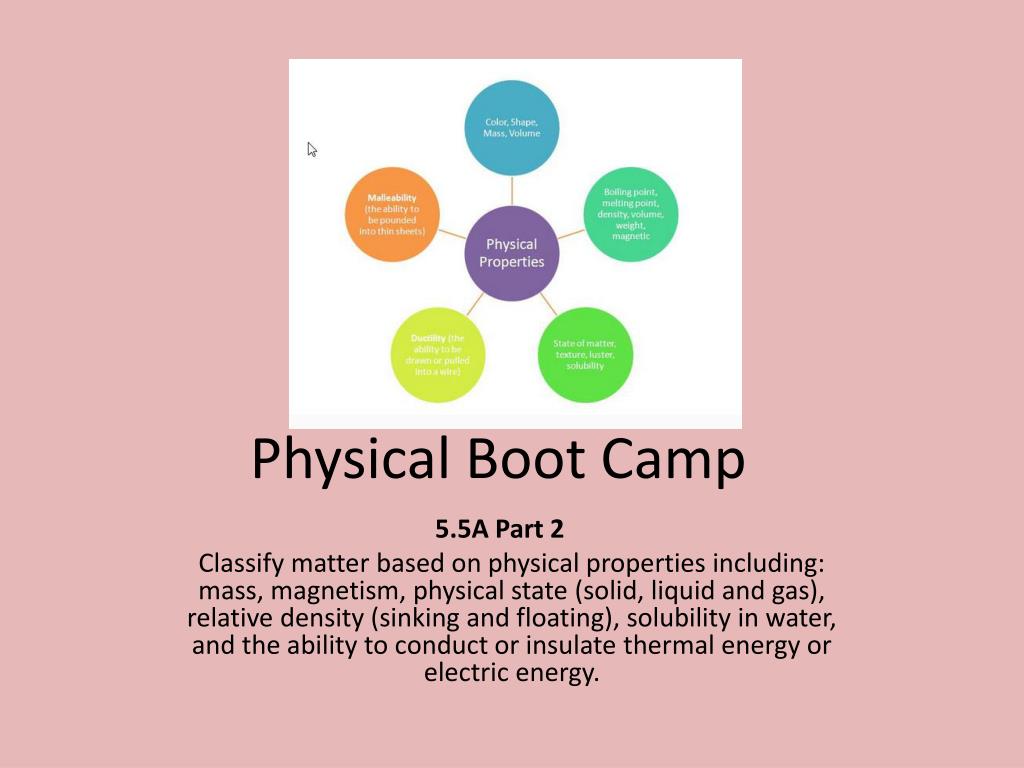
Physical Boot Camp. 5.5A Part 2 Classify matter based on physical properties including: mass, magnetism, physical state (solid, liquid and gas), relative density (sinking and floating), solubility in water, and the ability to conduct or insulate thermal energy or electric energy.
Une image / un lien ci-dessous est fourni (tel quel) pour télécharger la présentation
Politique de téléchargement : le contenu du site vous est fourni TEL QUEL pour votre information et votre usage personnel ; il ne peut être vendu, concédé sous licence ni partagé sur d’autres sites sans l’accord de son auteur.Le contenu vous est fourni TEL QUEL, pour votre information et votre usage personnel uniquement.Téléchargez la présentation en cliquant sur ce lien.Lors du téléchargement, si vous ne parvenez pas à télécharger une présentation, l’éditeur a peut-être supprimé le fichier de son serveur.Pendant le téléchargement, si vous ne parvenez pas à obtenir une présentation, le fichier a peut-être été supprimé par l’éditeur.
F I N
Plus de contenu associé
Transcription de la présentation
Physical Boot Camp 5.5A Part 2 Classify matter based on physical properties including: mass, magnetism, physical state (solid, liquid and gas), relative density (sinking and floating), solubility in water, and the ability to conduct or insulate thermal energy or electric energy.
64. A student found a metal object under her desk. How can she find out if the object is made of iron? A Drop the object in water to see if it floats. B Hit the object with a hammer to see if it breaks. C Place the object next to a magnet to see if it is attracted. D Rub the object on a piece of wool and see if she gets a shock.
64. A student found a metal object under her desk. How can she find out if the object is made of iron? A Drop the object in water to see if it floats. B Hit the object with a hammer to see if it breaks. C Place the object next to a magnet to see if it is attracted. D Rub the object on a piece of wool and see if she gets a shock.
65. Some wires are covered in plastic to protect people from electric shocks. Why is plastic a good choice for covering electric wires? A Plastic is a good insulator. B Plastic is a good conductor. C Plastic has a high density. D Plastic can be many colors.
65. Some wires are covered in plastic to protect people from electric shocks. Why is plastic a good choice for covering electric wires? A Plastic is a good insulator. B Plastic is a good conductor. C Plastic has a high density. D Plastic can be many colors.
70. Some useful properties of copper are listed below: • Bends without cracking • Stretches without breaking • Resists rusting • Conducts heat and electricity • Based on these properties, copper is MOST useful for making which products? • A Bridges • B Computer wires • C Furniture • D Gardening tools
70. Some useful properties of copper are listed below: • Bends without cracking • Stretches without breaking • Resists rusting • Conducts heat and electricity • Based on these properties, copper is MOST useful for making which products? • A Bridges • B Computer wires • C Furniture • D Gardening tools
76. Which of the following physical properties of water can cause a rock to break apart? A The boiling point of water is 100°C. B Water loses or gains energy slowly. C Water expands as it freezes. D Water has a high level of surface tension.
76. Which of the following physical properties of water can cause a rock to break apart? A The boiling point of water is 100°C. B Water loses or gains energy slowly. C Water expands as it freezes. D Water has a high level of surface tension.
77. A glass of ice water is placed on a table. After 10 minutes, there are drops of water on the outside surface of the glass. Which change in phase caused the drops of water? A Liquid water in the air evaporated into a gas. B Liquid water in the air condensed into a solid. C Water vapor from the air evaporated into a liquid. D Water vapor from the air condensed into a liquid.
77. A glass of ice water is placed on a table. After 10 minutes, there are drops of water on the outside surface of the glass. Which change in phase caused the drops of water? A Liquid water in the air evaporated into a gas. B Liquid water in the air condensed into a solid. C Water vapor from the air evaporated into a liquid. D Water vapor from the air condensed into a liquid.