Download
1 / 15
150 likes | 282 Vues
Learn about the concepts of rotation and revolution, angular and tangential speed, centripetal and centrifugal forces, and how a simulated gravitational acceleration can be produced. Explore examples and explanations surrounding the motion of objects in circular paths.

E N D
Notes: Chapter 10 Circular MotionObjectives: • Distinguish between rotation and revolution (10.1) • Describe rotational speed. (10.2) • Give examples of centripetal force. (10.3) • Describe the motion of an object if the centripetal force acts on it ceases. (10.4) • Explain why centrifugal force is “fictitious.” (10.5) • Describe how a simulated gravitational acceleration can be produced
10.1 Rotation and Revolution • Axis is a straight line around which rotation takes place. • Rotation is when an object turns about an internal axis; to spin. • Revolution is when an object turns about an external axis.
10.2 Rotational Speed • Angular displacement the angle through which a point, line, or body is rotated about a specific axis in a given direction. 1 rev = 360o = 2 rad
Rotational speed (angular speed) – number of rotations per unit of time. • Usually expressed in rad/s, rev/min (rpm), or rev/s
Tangential speed (linear speed) – speed of something moving along a circular path. • Expressed in m/s, cm/s, ft/s, or in/s • Formula only works when is expressed in rad/s
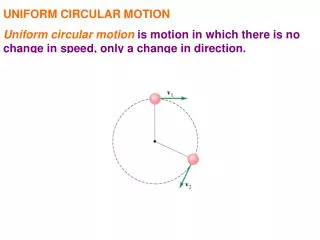
10.3 Centripetal Force • An object moving in a circular path undergoes and centripetal acceleration (ac). • Caused by a centripetal force (Fc)—a center directed force that cause an object to move in a curved, or circular path. • Examples: • Whirling a can on a string • Gravity between the Earth and the Sun • Friction keeping a car on the road as it travels a curve
Adding Force Vectors Whenever you want to identify a centripetal force on a circularly moving object, it will be the net force that acts exactly toward the center of the circular path. In Figures 10.12 and 10.13, it is the x-components.
10.4 Centripetal and Centrifugal Forces • Sometimes there is an apparent outward force attributed to circular motion. • Called centrifugal force (means center-fleeing). • The “centrifugal-force effect” is attributed not to any real force but to inertia—the tendency for a body to follow a straight-line path.
10.5 Centrifugal Force in a Rotating Frame of Reference • Frame of reference for moving car and • ground • another moving car • Forces also have frames of reference
Ladybug in can, force feels as real as gravity, an interaction force. • But the force on ladybug is due to circular motion. • Stop the circular motion and the force disappears. Thus centrifugal force is not an interaction and therefore a fictitious force. • Centrifugal force is an effect of rotation. It is not part of an interaction and therefore it cannot be a true force.