Understanding Inverse Functions and Trigonometry Concepts
This guide covers essential concepts in inverse functions and their relation to trigonometry. Beginning with the evaluation of functions like g(x) and its inverse, it explains the process of finding the inverse of linear functions. The guide also assesses the one-to-one nature of various functions, evaluates key trigonometric values, and explores inverse trigonometric functions with a focus on arcsine and arccosine in their restricted domains. Finally, approximate values are calculated using a calculator. Perfect for students looking to solidify their understanding of these concepts.

Understanding Inverse Functions and Trigonometry Concepts
E N D
Presentation Transcript
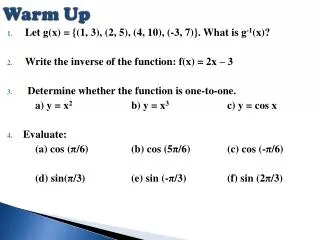
Warm Up • Let g(x) = {(1, 3), (2, 5), (4, 10), (-3, 7)}. What is g-1(x)? • Write the inverse of the function: f(x) = 2x – 3 • Determine whether the function is one-to-one. a) y = x2 b) y = x3 c) y = cos x • Evaluate: (a) cos (π/6) (b) cos (5π/6) (c) cos (-π/6) (d) sin(π/3) (e) sin (-π/3) (f) sin (2π/3)
Inverse Trig Functions Relate the concept of inverse functions to trig functions
Restricted Domain of sine = Range of sine = Domain of arcsin = Range of arcsin = Ex: Find arcsin(-½)
Examples: • Determine the exact value of each of the following. 1) arccos (-1/2) = 2) arcsin (-1/2) = 3) arccos (0) = 4) arcsin (0) = 5) arccos (-1) = 6) arcsin (-1) = 7) 8)
Use your calculator to find the approximate value of… • arcsin(-0.258) • arctan(28.3)