Understanding Inertia, Forces, and Free Body Diagrams in Physics
This lesson series focuses on the concepts of inertia and forces, emphasizing free body diagrams. Students will learn to describe inertia and its relation to mass and how net forces affect motion. Through engaging warm-up activities, they will explore unbalanced forces, inertia determination, and the distinction between mass and weight. They will practice drawing free body diagrams to illustrate forces acting on various objects, like a puck on ice or a man pushing against a wall. This foundational knowledge is essential for understanding dynamics in physics.

Understanding Inertia, Forces, and Free Body Diagrams in Physics
E N D
Presentation Transcript
Tuesday, October 18Learning Target(s): -I can describe inertia and relate it to an objects mass - I can draw and describe free body diagrams Warm Up -Write the following questions in preparation for the NFL films video (leave yourself some room between each question) What is an unbalanced force? What do they cause? A players resistance to an unbalanced force is called what? What determines a players inertia? How is mass different from weight?
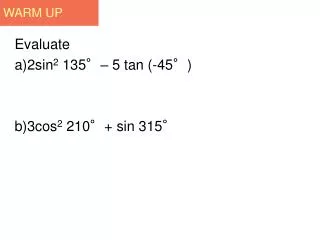
Wednesday, October 19Learning Target(s): - I can draw and describe free body diagrams - I can describe the effect of net force on motion Warm Up • Draw a free body diagram for an puck that is gliding across the ice to the right • What resistant force does the ice help reduce?
Friday, October 21Learning Target(s): - I can draw and describe free body diagrams - I can describe the effect of net force on motion Warm Up • A man punches a wall with a force of 50 Newton’s. Which statement is true? A.) The wall exerts a 20 N force back on his hand. B.) The wall exerts a 40 N force back on his hand. C) The wall exerts a 50 N force back on his hand. D) Walls are stationary objects, they cannot exert force.
Types of Forces Weight - force of gravity (Fgrav) Normal force – surface pushing back (Fnorm) Friction - resistance force (Ffric) Applied force - force you exert (Fapp) Tension - applied through a rope or chain (Ften) Net force – total vector sum of all forces (Fnet) Balanced forces – equal and opposite Unbalanced forces – not equal and opposite
Normal Force (FN) FN Examples: FN Wa l l REVIEW Defined as the force of a surface pushing back on an object. Always directed perpendicular to the surface. This is a contact force. No contact…no normal force. NOT always equal to weight. Table
Types of friction Static friction is always greater than kinetic friction! • Static friction is the force an object must overcome to start moving. • Kinetic friction is the force an object must overcome to keep moving.
A man is pushing a box hard enough to keep it still on a 300 ramp