Download
1 / 11
110 likes | 236 Vues
Adolescence is a critical transitional stage between childhood and adulthood, marked by various physical, emotional, and social changes. In this exploration of adolescent development, we delve into Erikson's stages, particularly focusing on identity formation. We'll create a developmentally supportive toy suitable for a selected age group, reflecting on how it fosters growth during this stage. Additionally, we will examine rites of passage, both in the U.S. and globally, to understand how culture influences adolescent experiences. Personal reflections and challenges faced during this period will also be discussed.

E N D
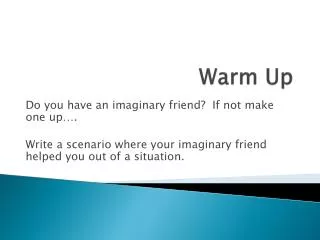
Warm Up • How would you define “Adolescence”?
Enrichment • Create a toy for a child (you select the age) that would help them to develop while in the Erikson stage • Use handout to guide you, then draw a picture to represent your toy
Quote of the Week! • “I was always looking outside myself for strength and confidence. But it comes from within. It is there all the time.” • -Anna Freud
CHILDHOOD ADOLESCENCE • Adolescence- transition period between childhood and adulthood • Preparation for adult responsibilities
Initiation Rites • Ceremonies or rituals when an individual is admitted to new status/position • Also known as Rites of Passage
Let’s go global! • Read through the example rites of passage with your partner. • Summarize each in 2-3 sentences.
Theories of Adolescence • Hall- adolescence represents a transitional stage • “Something like being a fully grown animal in a cage, an animal that sees freedom but does not know quite when freedom will occur or how to handle it.” • Stressful, confusing, troubling time
Theories of Adolescence • Mead- adolescence is a highly enjoyable time of life, not stressful • Stress is a by-product of society • Culture role in development
HavighurstChallenges • 1-Accepting one’s physical makeup • 2- Developing appropriate relations • 3-Becoming emotionally independent • 4-Achieving socially responsible behavior • 5-Deciding on the future
Personal Development • Read pages 101-104 (Stop at Identity Development) • For each section • (Cognitive Development, Moral Development) • Develop “what if” statements (3) • Relate the text to your own experience • Discuss the challenges an adolescent may face • Discuss factors which influence