Download
1 / 16
160 likes | 277 Vues
Discover the fascinating world of carbon atoms, focusing on the structure of the electron cloud and the importance of valence electrons. This overview breaks down essential concepts such as electron shells, the Bohr model, and electron dot diagrams. Learn how the "rule of eight" influences atomic stability and reactions, leading to electron sharing and transferring between atoms. By simplifying complex models, we can better understand the behavior of carbon and its role in chemistry, paving the way for further exploration into atomic interactions.

E N D
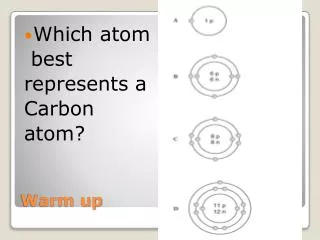
Which atom best represents a Carbon atom? Warm up
Electron Cloud It’s a small world after all PLEASE!!!! Do not sing this terribly annoying song
The electrons swirling around the nucleus of an atom are called the electron cloud. • This ‘cloud’ contains all the electrons in a given atom. Valence electrons
The electron cloud has different energy levels that electrons must follow in, called electron shells. • We will only look at the first three. • The following shells can hold: 1st shell-Up to 2 electrons 2nd shell- up to 8 electrons 3rd shell- up to 18 Electron cloud
Vocab: Valence electrons: Electrons on the outermost shell of an atom. • So how many valence electrons do these atoms have? Valence electrons
model- a simple version of a more complicated system or concept. Models make something easier to understand. Models
Just label the shells • The Bohr Model The Bohr model- shows ALL the electrons, protons, and neutrons in an atom. Draw in IAN
Scientist use a more simple way to represent atoms and their valence electrons than the Bohr model. • An electron dot diagram shows ONLY the valence electrons of an atom and its name. • Next, draw the same carbon atom using the electron dot diagram. Electron dot diagrams
Draw in IAN the C (Carbon atom) and draw an arrow to the valence electrons. Electron Dot model Bohr model Bohr model vs. Electron dot
Vocab: • Rule of eight- all atoms want to have 8 valence electrons to fill up their outer shell. • The atom will do whatever it can to make the rule of 8. This is a perfect time to introduce the atoms rule of eight
The atom will give valence electrons away or steal from other atoms to make their outer shell have 8 electrons. Electrons, not money----> This is a perfect time to introduce the atoms rule of eight
An atom reacts with another atom based on its # of valence electrons. (electrons on the outer shell) • An atom is unstable and wants to react because of its # of valence electrons. • EVERY chemical reaction happens because # of valence electrons
This ‘stealing’ and ‘sharing’ is how ALL reactions happen!!! Lets do this on the board!!!!!
Another example. • The electron is stolen by the Cl atom and the Na atom wants to get rid of it • Why?