Using Adjectives
This guide explores the essential rules for using adjectives in Spanish, focusing on their necessary agreement with nouns in gender (masculine and feminine) and number (singular and plural). It highlights exceptions and features common adjectives such as "deportista" and "sociable," which do not change form. Additionally, the text outlines the conjugation of the verb "ser" in the present tense and the conjugation rules for -ar, -er, and -ir verbs. It also covers how to construct questions with various interrogative words.

Using Adjectives
E N D
Presentation Transcript
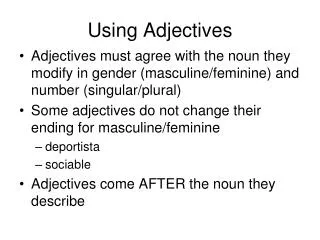
Using Adjectives • Adjectives must agree with the noun they modify in gender (masculine/feminine) and number (singular/plural) • Some adjectives do not change their ending for masculine/feminine • deportista • sociable • Adjectives come AFTER the noun they describe
Grammar Point: -er and -ir verb conjugation(present indicative)
Grammar Point: Questions ¿Cómo… How ¿ Qué… What ¿ Cuál… Which/What ¿ Cuándo… When ¿ Cuánto(a)… How much ¿ Cuántos(as)… How many ¿ Por qué… Why ¿ Quién… Who ¿ Con quién… With whom ¿ Dónde… Where ¿ Adónde… To where ¿ De dónde… From where