Understanding Molar Mass and Conversions in Chemistry
Dive into the basics of molar mass and its applications in chemistry. This lesson covers the atomic masses of elements such as Cl, Fe, and compounds including KCl and H2O. Learn how to calculate molar masses by summing the atomic masses of constituent elements, and apply your knowledge through practical examples, including finding the molar mass of H2O2, Al2O3, and Fe2O3. Understand conversions between moles and mass with guided exercises, and test your skills with practice problems.

Understanding Molar Mass and Conversions in Chemistry
E N D
Presentation Transcript
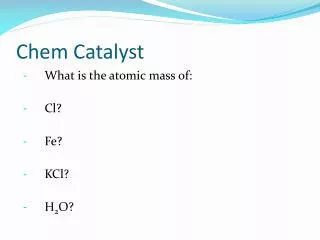
Chem Catalyst • What is the atomic mass of: • Cl? • Fe? • KCl? • H2O?
Today’s Agenda: • Catalyst • Notes- Molar mass • HW: p. 296 # 7, 8; p. 303 #26,27
Molar Mass • Periodic table gives mass in amu- same as the mass in grams of 1 mole of that substance [g/mol] • For compounds: add mass of all elements to find total mass in g/mol.
Finding Molar Mass • Find the molar mass of H2O2 • Find the molar mass of Al2O3 • Find the molar mass of Fe2O3
Conversion: Moles to Mass • Multiply by (molar mass/ 1 mol) • Ex: What is the mass of 9.45 mol of Al2O3?
Conversion: Mass to Moles • Multiply by (1 mol/ molar mass) • Ex: How many moles of iron (III) oxide are contained in 92.2g of Fe2O3?
Practice: • Calculate the mass, in grams, of 2.50 mol Fe(OH)2 • Find the mass of 3.00 mol of NaCl • Find the number of moles in 0.370 g of Boron. • Calculate the number of moles in 75.0 g of dinitrogen trioxide.