Understanding Oxidation and Reduction: A Guide to Electrochemistry
Explore the fundamentals of electrochemistry with this comprehensive guide on oxidation and reduction. Learn how ions are formed through the loss and gain of electrons, understand the concepts of redox reactions, and practice writing redox equations. Discover real-world applications of these reactions, such as the corrosion of metals and methods to prevent it through protective coatings. This resource covers key definitions, principles, and practices necessary for mastering the topics in Chapter 20 and some of Chapter 21 on electrochemistry.

Understanding Oxidation and Reduction: A Guide to Electrochemistry
E N D
Presentation Transcript
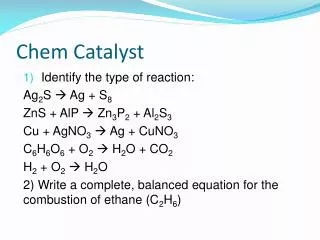
Chem Catalyst How is an ion formed?
Today’s Agenda: • Do Now • Intro: New Chapter • Notes- Oxidation & Reduction • Practice Worksheet
New Topic: Electrochemistry Chapter 20 (and some Chapter 21) • Oxidation and Reduction • Writing Redox Reactions • Voltaic cells/batteries
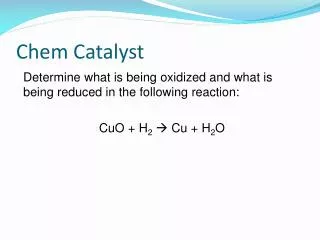
Oxidation Reactions • Originally defined as combining the element with oxygen • Now defined as loss of electrons (shift of electrons away from an atom) • Charge becomes more positive (increases)
Reduction Reactions • Originally defined as removing oxygen from a compound with the element • Now defined as gain of electrons (shift of electrons toward an atom) • Charge becomes more negative (charge decreases) • Occurs alongside an oxidation reaction
Redox Reactions • A reaction that includes oxidation and reduction • The substance that gains electrons is reduced • The substance that loses electrons is oxidized • “LEO the lion goes GER” • Losing Electrons is Oxidation; Gaining Electrons is Reduction
Redox Reactions: Practice Identify the element being reduced and the element being oxidized: Hint: break apart the ionic compounds 2AgNO3 + Cu Cu(NO3)2 + 2Ag
Redox Reactions: Practice Identify the element being reduced and the element being oxidized: 2Na + Br2 2NaBr
Applications of Redox: • Some metals (gold, platinum) are not easily oxidized • Iron is oxidized by oxygen, causing corrosion • Can be coated w/ aluminum, whose oxide does not corrode • Connect to an easily oxidized metal (zinc, magnesium) which will transfer electrons to iron