Understanding Rotational Motion: Torque, Inertia, and Angular Momentum
80 likes | 205 Vues
Explore the fundamentals of rotational motion with a focus on Earth's rotation, torque, inertia, and angular momentum. Learn how the Earth revolves around the sun annually and rotates daily, affecting its rotational velocity. Discover how torque is calculated using force and lever-arm length, illustrated with a practical example involving a wrench. Understand the concept of balance on a seesaw through rotational inertia and how angular momentum plays a critical role in activities like bicycle riding. Engage with these principles and their real-world applications.


Understanding Rotational Motion: Torque, Inertia, and Angular Momentum
E N D
Presentation Transcript
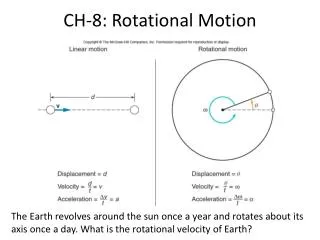
CH-8: Rotational Motion The Earth revolves around the sun once a year and rotates about its axis once a day. What is the rotational velocity of Earth?
Torque, τ Torque depends on the applied force and lever-arm. Torque = Force x lever-arm Torque is a vector. It comes in clockwise and counter-clock wise directions. Unit of torque = N•m P: A force of 40 N is applied at the end of a wrench handle of length 20 cm in a direction perpendicular to the handle as shown above. What is the torque applied to the nut?
Application of Torque: Weighing P. A child of mass 20 kg is located 2.5 m from the fulcrum or pivot point of a seesaw. Where must a child of mass 30 kg sit on the seesaw in order to provide balance?
Rotational Inertia Rotational Inertia = mass x square of distance from axisI =mr2Rotational inertia is a scalar. Unit for I = kg.m2
Angular Momentum or Rotational Momentum Angular momentum is the product of the rotational inertia and rotational velocity. L = I·ω Conservation of Angular Momentum
Angular momentum and Bicycles Explain the role of angular momentum in riding a bicycle?