
SlideServe
Menu
Préférences
© SlideServe · v2026

Hydrolysis and Neutralization

crete avatar
10 diapositives · 651 Views · Sep 26, 2014

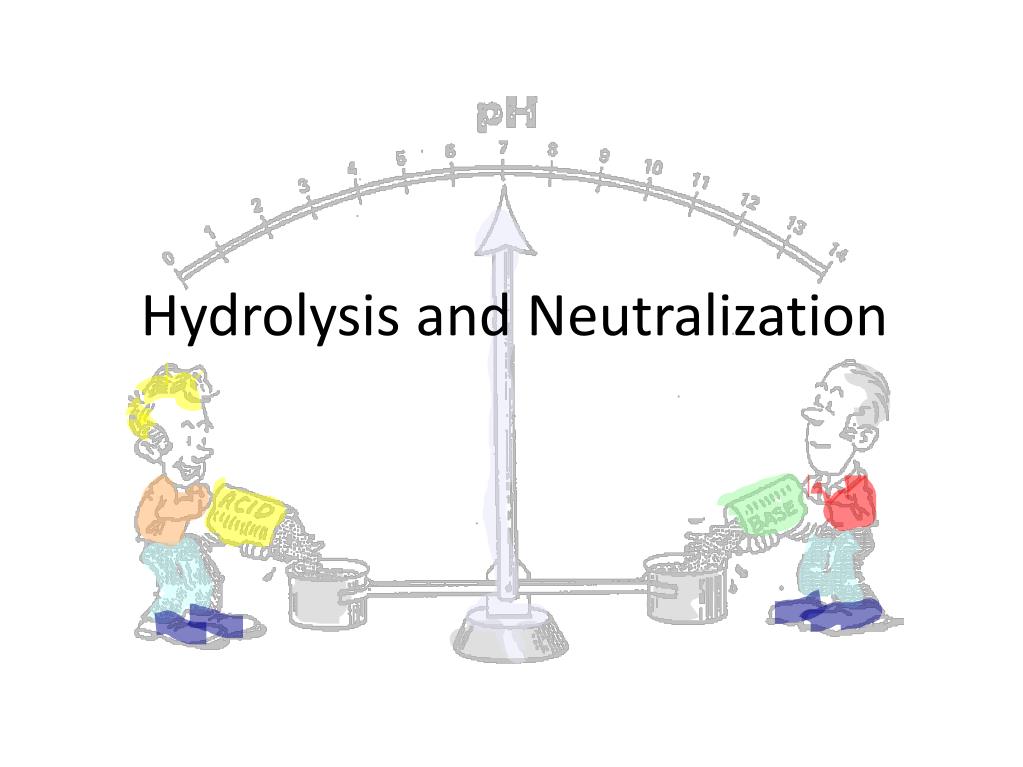
Hydrolysis and Neutralization. Predict whether an aqueous solution of a given ionic compound will be acidic, basic or neutral given the formula . Write balanced neutralization reactions involving strong acids and bases. Additional KEY Terms salt hydrolysis.
Hydrolysis and Neutralization - slide 1
01 / 10Hydrolysis and Neutralization
1 / 17

Télécharger la présentation

Hydrolysis and Neutralization
Une image / un lien ci-dessous est fourni (tel quel) pour télécharger la présentation

Politique de téléchargement : le contenu du site vous est fourni TEL QUEL pour votre information et votre usage personnel ; il ne peut être vendu, concédé sous licence ni partagé sur d’autres sites sans l’accord de son auteur.Le contenu vous est fourni TEL QUEL, pour votre information et votre usage personnel uniquement. Téléchargez la présentation en cliquant sur ce lien. Lors du téléchargement, si vous ne parvenez pas à télécharger une présentation, l’éditeur a peut-être supprimé le fichier de son serveur.Pendant le téléchargement, si vous ne parvenez pas à obtenir une présentation, le fichier a peut-être été supprimé par l’éditeur.

F I N

Plus de contenu associé

Transcription de la présentation
  1. Hydrolysis and Neutralization

  2. Predict whether an aqueous solution of a given ionic compound will be acidic, basic or neutral given the formula. • Write balanced neutralization reactions involving strong acids and bases. Additional KEY Terms salt hydrolysis

  3. Neutralization reaction (double replacement): acid + base salt + water Ionic compound produced by reacting an acid with a base. • When saltdissociates in water it canreact and produce an acidic or basic solutions • We call this process salt hydrolysis

  4. acid + base salt + water • 3 possible neutralization outcomes: • SA + SB - results in neutral solution, pH = 7 • 2. WA + SB – results in basicsolution pH > 7 • 3. SA + WB – results in acidic solution pH < 7

  5. HCl(aq) + NaOH(aq) NaCl(aq) + H2O(l) • SA + SB - results in neutral solution, pH = 7 • strongacid/base leaves behind weak conjugates • so weak to be unreactive leaving neutral solution Na+ + Cl- weak CB • anions of strongest acids won’t affect pH: • Cl-, ClO4-, I-, Br-, NO3-(weakest CBs)

  6. CH3COO-(aq) + H2O(l) OH-(aq) + CH3COOH (aq) CH3COOH(aq) + NaOH (aq) CH3COONa (aq) + H2O(l) weak acid 2. WA + SB – results in basicsolution pH > 7 • weakacids leaves behind strong conjugate base • strong anion reacts to form basic solution Na+ + CH3COO¯ strong CB

  7. NH4+(aq) + H2O (aq) H3O+(aq) + NH3 (aq) HNO3(aq) + NH3 (aq) NH4NO3 (aq) + H2O(l) • 3. SA + WB – results in acidic solution pH < 7 • weakbases leaves behind strong conjugate acid • strong cation reacts to form acidic solution weak base NH4+ + NO3¯ strong CA

  8. Is K2CO3, acidic, basic or neutral? Step 1. Identify the ions present. Potassium carbonate will dissociate in water K2CO3(s) → 2 K+(aq) + CO32–(aq) strong CB Step 2. Determine if each ion will affect the pH. Carbonate ion is a strong CB of weak acid HCO3– CO32– (aq) + H2O (l)  HCO3– (aq) + OH– (aq) Solution is basic

  9. Other Salts: Metal salts containing 3+ or 2+ transition metal ions, will be acidic in water. FeCl3 is acidic in water: Fe(H2O)63+ + H2O  H3O+ + Fe(H2O)5(OH)2+ Oxides are basic in water because oxide ion, O2–, is a strong base. – (Na2O) O2–(aq) + H2O(l) → OH–(aq) + OH–(aq)

  10. CAN YOU / HAVE YOU? • Predictwhether an aqueous solution of a given ionic compound will be acidic, basic or neutral given the formula. • Write balanced neutralization reactions involving strong acids and bases. Additional KEY Terms salt hydrolysis